Caloric Content of Two Foods
Introduction:
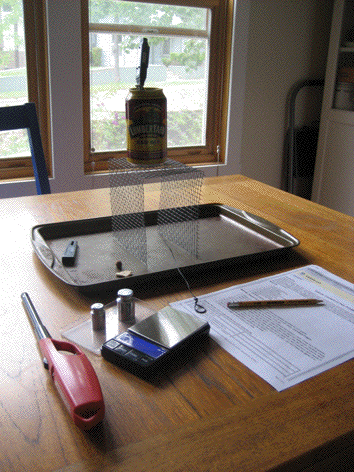
Calorie Lab Setup
Millions of people have been conditioned to count calories in their food and have learned (surprise!) that fatty foods are fattening. Most, however, have little idea what a calorie actually is. It is a unit of energy, just like the joule, the kilowatt-hour, or the foot-pound. The "Calorie" of diet fame is simply the amount of heat energy it would take to raise one kilogram of water one degree Celsius in temperature. In this investigation we will attempt to measure the amount of energy (Calories) released from burning two food items with differing proportions of fats and carbohydrates. Watch this video for an overview.
Note: The Calorie used in diet measurements is a "big C" Calorie. In chemistry, the big C Calorie is sometimes referred to as a kcal, or kilo-calorie, because it is equal to 1000 "small c" calories. Throughout this exercise, we are always referring to the big C Calorie, also known as the kilocalorie.
Materials:
- Empty aluminum can
- Butane lighter
- Lab thermometer (analog or digital; metric/celsius scale preferred)
- Dissecting probe
- Wire screen/stand
- Aluminum foil or cookie sheet tray
- Electronic scale sensitive to 0.01 grams
- Forceps or test tube holder
- Walnut
- Cracker
Methods:
- Weigh your two food items on an electronic balance sensitive to 0.01 grams.
- Weigh the empty can, then fill it about 1/4 to 1/3 full with water, and weigh it again.
- Record the initial temperature of the water in the can.
- Set the can on the stand with the thermometer in it (careful not to knock it over; it may be a bit wobbly), and place a piece of foil or a small aluminum tray under the stand to catch any falling soot.
- Carefully impale the food item on the probe, ignite it with the lighter, and then hold it directly under the can until it burns itself out and won't re-light. (Hint: You may need to rotate the food item to keep it lit, and it will burn more cleanly if the tip of the flame is just below the can, but the food must burn on its own...you can't keep the lighter lit or you will be measuring the calories of the gas in the lighter.)
- Record the highest temperature reached by the water. Repeat the procedure with the second food item. You can re-use the water in the can, but need to record the new starting and ending temperatures.
- When finished, clean up and analyze your data.
Results (Part A): Fill in the following table while doing the lab. If you like, you can do your calculations using this pre-built Excel spreadsheet.
|
Mass of the empty can (g) |
||
|
Mass of water + can (g) |
||
|
Mass of just the water (g) |
||
|
Mass of water in the can (kg) Convert from grams |
||
|
Important: Each of the following measurements needs to be taken twice; once for each food type. |
||
|
Mass of food item (g) |
||
|
Initial temp of water (℃) |
||
|
Highest temp of water (℃) |
||
|
Temperature change (℃) |
||
Analysis:
- Calculate the number of calories in your food using the equation below. Don't let the units confuse you. They will cancel out. Simplified, it's just Calories = water mass * temp change.
- Divide total calories of each food item by its mass to obtain Calories per gram.
Q = m * c * ΔT
energy absorbed by water = mass of water * specific heat of water * temperature change
Calories = (Mass of water in kg) * [(1 Calorie) / (1 kg)(1℃)] * (temp change in ℃)
Results (Part B):
|
|
|
|
|
Calories absorbed by water (Cal): |
||
|
Calories per gram of food (Cal/g): |
Fat: 1 gram = 9 Calories
Protein: 1 gram = 4 Calories
Carbohydrates: 1 gram = 4 Calories
Alcohol: 1 gram = 7 Calories
Some Final Calculations
Read the labels on the packages where you got the nut and cracker. In this example, we used an almond and a Cheeze-It cracker.
Divide the total calories by the serving size in grams to get the expected calories/gram for the two foods.
- Almond nut: 250 Cal / 43 g = 5.8 Cal / g
- Cheeze-It cracker: 280 Cal / 56 g = 5 Cal / g
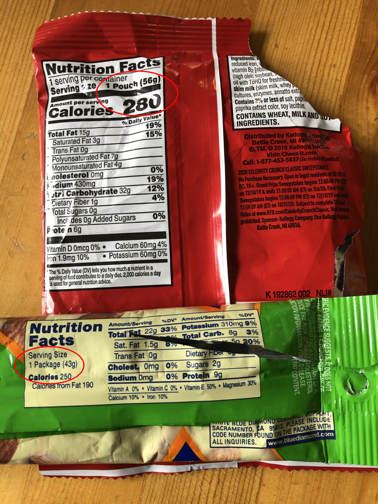
Calories per gram from package labels
Questions:
- Why do animals consume food? Why do animals need oxygen?
- What does burning the foods do to them? How does this relate to respiration and digestion?
- Where does the energy in the foods come from?
- What was the purpose of the water in the can? Why didn't it matter exactly how much water was in the can?
- Why will our technique almost certainly underestimate the actual number of calories? Refer here for true values.
- Though our method is crude, why is there still validity in the comparison across the two foods?
- Gram for gram, how should a food rich in fats compare to a food rich in carbohydrates?
- Which food would you predict to contain more fats or more carbohydrates?
- What did you observe about differences in the way the two food items burned?
- Why would it throw off your results if you kept the food under the lighter flame throughout?
- If the food was not completely burned, how would this affect your results?
- If heat was lost to the air, how would this affect your results?
- What is the practical value of this technique (which is known as calorimetry)?
- Why did we need to compute calories per gram instead of just total calories?
- What does the phrase "empty calories" mean, and why is that term misleading?
- Which food (nut or cracker) had more calories per gram in your experimental (observed) data?
- Which food (nut or cracker) had more calories per gram in the expected values obtained from the package labels?
- Which values (observed vs expected) were higher? Suggest some reasons why.
- Did the values trend in the same direction? (Was the same food higher in Cals / g in both observed and expected?)
- Could a person live for a long time off of just soda pop and vitamins?