
Land and aquatic energy pyramids
Have you ever wondered why we can't seem to feed the world's hungry? It's a complex issue, but it might surprise you to learn that it's not because there isn't enough food; current agricultural capacity, based on current technology, exists to feed as many as 10 billion people. The Earth's population is "only" about 7 billion. The big question really is: If we want to feed everyone, what would everyone need to eat? To answer that question, download this excel spreadsheet and try plugging in some numbers.
Example: One acre of a grain crop could be used to feed cattle, and then the cattle could be used to feed people. If 50% of the energy is lost to the cattle, you could feed twice as many people if you fed them the grain directly. Another way of looking at it is that it would only take a half acre of land to feed the people grain, but a whole acre if you feed the grain to the cattle and the cattle to the people. A common practice to grow cattle faster is to feed them ground up animal protein. This means that when we eat the meat from the cow, we're at the tertiary level or higher. The loss of energy between trophic levels may also be even higher. Recent studies suggest that only ~10% of energy is converted to biomass from one trophic level to the next!
The Food Chain: The answer has to do with trophic levels. As you probably know, the organisms at the base of the food chain are photosynthetic; plants on land and phytoplankton (algae) in the oceans. These organisms are called the producers, and they get their energy directly from sunlight and inorganic nutrients. The organisms that eat the producers are the primary consumers. They tend to be small in size and there are many of them. The primary consumers are herbivores (vegetarians). The organisms that eat the primary consumers are meat eaters (carnivores) and are called the secondary consumers. The secondary consumers tend to be larger and fewer in number. This continues on, all the way up to the top of the food chain. About 50% of the energy (possibly as much as 90%) in food is lost at each trophic level when an organism is eaten, so it is less efficient to be a higher order consumer than a primary consumer. Therefore, the energy transfer from one trophic level to the next, up the food chain, is like a pyramid; wider at the base and narrower at the top. Because of this inefficiency, there is only enough food for a few top level consumers, but there is lots of food for herbivores lower down on the food chain. There are fewer consumers than producers.
Land and aquatic energy pyramids
| Trophic Level | Desert Biome | Grassland Biome | Pond Biome | Ocean Biome |
|---|---|---|---|---|
| Producer (Photosynthetic) | Cactus | Grass | Algae | Phytoplankton |
| Primary Consumer (Herbivore) | Butterfly | Grasshopper | Insect Larva | Zooplankton |
| Secondary Consumer (Carnivore) | Lizard | Mouse | Minnow | Fish |
| Tertiary Consumer (Carnivore) | Snake | Snake | Frog | Seal |
| Quaternary Consumer (Carnivore) | Roadrunner | Hawk | Raccoon | Shark |
Food Web: At each trophic level, there may be many more species than indicated in the table above. Food webs can be very complex. Food availability may vary seasonally or by time of day. An organism like a mouse might play two roles, eating insects on occasion (making it a secondary consumer), but also dining directly on plants (making it a primary consumer). A food web of who eats who in the southwest American desert biome might look something like this:
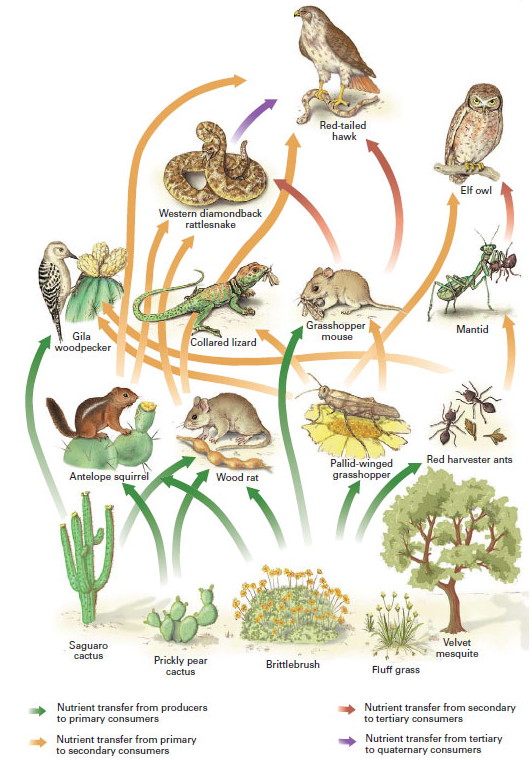
image source: http://iqa.evergreenps.org/science/biology/ecosystem_files/food-web.jpg
Keystone Species: In some food webs, there is one critical "keystone species" upon which the entire system depends. In the same way that an arch collapses when the keystone is removed, an entire food chain can collapse if there is a decline in a keystone species. Often, the keystone species is a predator that keeps the herbivores in check, and prevents them from overconsuming the plants, leading to a massive die off. When we remove top predators like grizzly bears, orca whales, or wolves, for example, there is evidence that it affects not just the prey species, but even the physical environment.
Apex Predators: These species are at the top of the food chain and the healthy adults have no natural predators. The young and old may in some cases be preyed upon, but they typically succumb to disease, hunger, the effects of aging, or some combination of them. The also suffer from competition with humans, who often eliminate the top predators in order to have exclusive access to the prey species, or through habitat destruction, which is an indirect form of competition.
Decomposers: When organisms die, they are sometimes eaten by scavengers but the remaining tissues are broken down by fungi and bacteria. In this way, the nutrients that were part of the body are returned to the bottom of the trophic pyramid.
Bioaccumulation: In addition to being less energy efficient, eating higher up the food chain has its risks. Pesticides and heavy metals like mercury, arsenic, and lead tend to be consumed in small quantities by the primary consumers. These toxins get stored in the fats of the animal. When this animal is eaten by a secondary consumer, these toxins become more concentrated because secondary consumers eat lots of primary consumers, and often live longer too. Swordfish and tuna are near the top of the aquatic food chain and, when we eat them, we are consuming all of the toxins that they have accumulated over a lifetime. For this reason, pregnant women are advised against eating these foods.
1. Given: 10 billion people can be fed a basic vegetarian diet that is nutritionally complete. How many people could we feed at the American standard-a tertiary level of consumption (3rd order consumers?). 50% of the energy is lost by each higher level.
2. If there are 250 million people in the United States most of them eating at the Tertiary (3rd) level of consumption, how many people could we feed at the Primary level?
3. Some animals like sharks are 5th order consumers! Sharks eat tuna that eat mackerel that eat herring that eat copepods that eat diatoms. If we were to make the reasonable assumption that each of these animals eats 2 of its prey each day, how many organisms died to feed the shark in one day?