Perform the following simple experiments to stimulate your sensory system. Some of these experiments work best with a partner. Write a brief report which describes your experiences and answers the questions below. As you will learn, there are many more senses than the traditional five, and there is also a lot of interaction between them.
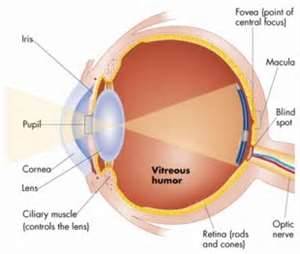
A. Rods and cones: The retina is a thin layer of neural tissue lining the back inside of the eyeball; this tissue contains the receptors for vision that are called "rods" and "cones." Cones are color sensitive and work best in bright light. Rods are more light sensitive and work better in dim light but are not sensitive to color, so they are important to night vision. Cones are most densely concentrated in the center of the retina, while rods are more concentrated around the periphery of the retina.
Experiment 1: Sit in the dark for a few minutes to let your eyes adjust. In near darkness, stare directly at an object and attempt to make out the details. Now look at it using your peripheral vision (from the side). Can you make it out more clearly? How does this relate to rods and cones? Try this trick while stargazing and you'll see more!
Experiment 2: Lay several colored objects in front of you, and very slowly bring up the lights from full darkness. Why can you see but not easily identify colors in dim light? How does this relate to rods and cones?
B. The Blind Spot: The retina is like a projection screen on which the image is focused by the lens of your eye. Within the retina however, there is a small area where the optic nerve connects to the eye; this area is called the papilla. There are no light sensitive cells in this area, which is called the blind spot. No visual information is sent to the brain from the part of your field of vision projected onto the papilla. One interesting bit of trivia is that the cephalopod eye (found in the invertebrate molluscs like octopus and squid) evolved independently from the vertebrate eye and, because of a different internal design, lacks a blind spot.
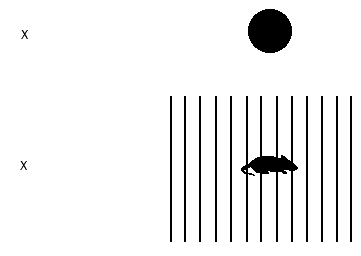
Blind spot test
Experiment 1: Hold your left hand over your left eye while staring directly at the upper X with your right eye, and slowly approach the screen until the black spot disappears (about a foot away from the screen). You have found your blind spot. With both eyes open, why can't you find your blind spot?
Experiment 2: Now repeat this procedure while looking at the "X" in the lower panel. When the mouse disappears, what happens to the bars of the cage? How can you "see" something in what you know is your blind spot? Why do you see the bars but not the mouse?If you have trouble finding your blind spot, remember to move your head very slowly towards the screen with your left eye covered.
C. Afterimages: A change in sensitivity limited to a restricted region of the retina is called local adaptation. This can result in the production of afterimages.
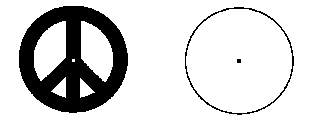
Afterimage test
With one eye covered, fixate on the white dot in the center of the "peace symbol" on the left for about 30 seconds. Then fixate on the black dot in the middle of the circle to the right. Describe what you see in the white circle. How has the sensitivity of your retina changed after staring at the dark geometric shape? How long do you continue to see the afterimage?
D. Compensation: Is a blind person's sense of hearing or smell enhanced, or is a blind person just doing more with the same information than a sighted person does?
E. Optical Illusions: In some cases, as with the blind spot experiment, the brain fills in missing information to compensate for the "missing data" coming from the blind spot region, but it can only fill in a regular pattern by sampling the area around the missing data. In other cases, perception (which occurs in the brain) can be fooled by what the eye sees accurately. In each of these examples, try to identify why your perception is being fooled. Note in the figure of the eye above that the image that comes to the eye is projected upside down onto the retina. How is it, then, that we see things "right side up"?
F. Color Blindness: Due to a mutation on the X chromosome, males are more likely to express color blindness than females since females (who are XX) have a "backup" X and males (who are XY) don't. About 5% of males have some degree of red-green color blindness. Do you know any colorblind men? Do you know any colorblind women? On the following test chart, everyone can easily distinguish the orange circle but people with red-green colorblindness will have difficulty identifying the red star. How did you do?
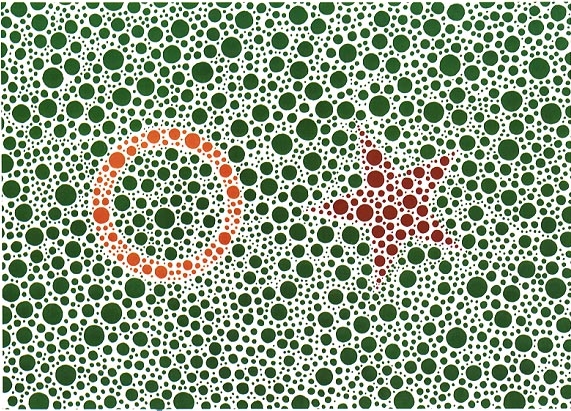
Colorblindness test
G. Vision Test: 20:20 vision means that at a distance of 20 feet, you can distinguish the letters on a chart as well as the average person can at 20 feet. A person with 20:100 vision is very nearsighted because what they can only see at 20 feet, an average person can see at 100 feet. A person with 30:20 vision has better than average "visual acuity" because they can see at 30 feet what the average person can only see at 20. Sometimes these "acuity ratios" are divided through to give a single number. In that case, a number greater than 1 means above average visual acuity while a 1 is average and a number less than 1 indicates below average visual acuity.
Download this vision chartor this one
2. Taste (Gustation) and Smell (Olfaction)
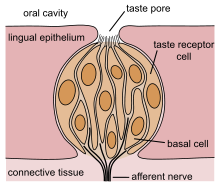
Receptors for taste and smell are called chemoreceptors. The taste buds, which are distributed all over the tongue, can detect five quite distinct taste sensations: sweet, sour, salty, umami (savory), and bitter. However, the flavor of foods is also strongly influenced by the sense of smell. The mouth cavity is open to the nasal cavity, so molecules can diffuse from the mouth up to the odor receptors in the nose.
A. Effect of smell on taste: Have you noticed that when you have a head cold, things often don't taste quite right? That's because your nasal sinuses are blocked. Perform the following experiment to determine how your sense of taste is affected by smell:
- Unwrap two hard candies with very different flavors (butterscotch and mint, for example) and place them in front of you.
- Pinch your nose and close your eyes, so you can't tell which candy you'll be tasting.
- Place a candy on your tongue. Let it remain there for a few seconds.
- Take that candy off your tongue and guess which flavor it is.
- Rinse with water between tastes.
- Try again with the second candy.
- Repeat with your eyes still closed but, this time, don't pinch your nose.
B: Satiation: Have you noticed that when you first enter a room, you may smell something strongly but, after a few minutes in the room, you no longer notice the smell or find it much less intense? This is called satiation. It's not that the scent has faded, but that your receptors are all blocked by the scent molecules and are no longer sending the signal to your brain. If someone new enters the room, they may comment on the scent that you detected before but no longer notice.Soak a tissue with perfume and have the subject take a good sniff and remain near the soaked tissue for 5-10 minutes of exposure. Have the subject describe the smell again after the exposure. Is it less intense? Send the subject out of the room for a few minutes for some fresh air. When they come back, ask them to describe the smell again and compare it to their first exposure. Does it seem stronger again? It's not that the smell has dissipated but that the receptors have cleared while the subject got some fresh air.
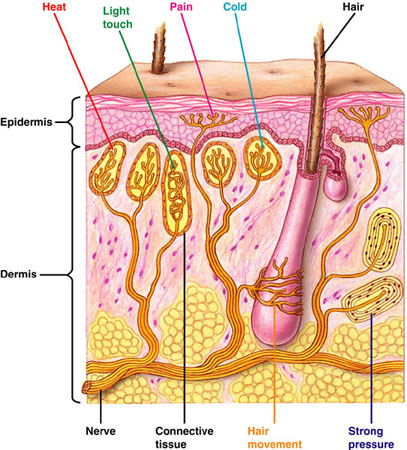
A. Simultaneous Spatial Threshold:What distances did you measure for each area? Why do you think that these distances vary so much?What parts of the body might have the smallest spatial threshold?What parts have the largest spatial threshold?
Unbend a paper clip and re-bend it so the two tips are close together. Measure the distance.
While your partner closes his or her eyes, place the two tips of the paper clips simultaneously on the back of his/her arm. Ask your partner if he or she feels two tips or one.
Change the distance between the two tips. Every now and then, touch them with just one tip to be sure they aren't just guessing "two" all the time.
By doing this procedure repeatedly, you should be able to get a good estimate of the simultaneous spatial threshold of the back of the arm. Measure this distance with a ruler.
Repeat using the back of the hand and the palm of the hand and compare results. Which of the three areas is the most sensitive? Which is the least?
B. Temperature Perception: Have you ever noticed that when you first get into a bathtub of hot water you can barely tolerate it and, only a few minutes later, it seems fine? The sensation of temperature is not absolute - the sensation is eventually reduced. To demonstrate this phenomenon, prepare three basins of water; one with hot water, one with lukewarm water, and one with ice water.
Have the subject place one hand in hot water and the other hand in ice water. After at least 1 minute of immersion, have your partner place one hand in the lukewarm water and describe the temperature. Then have them place the other hand in the same basin and again describe the temperature.
Why is it that although both hands experience the same temperature, the sensation differs?
4. Hearing and Balance
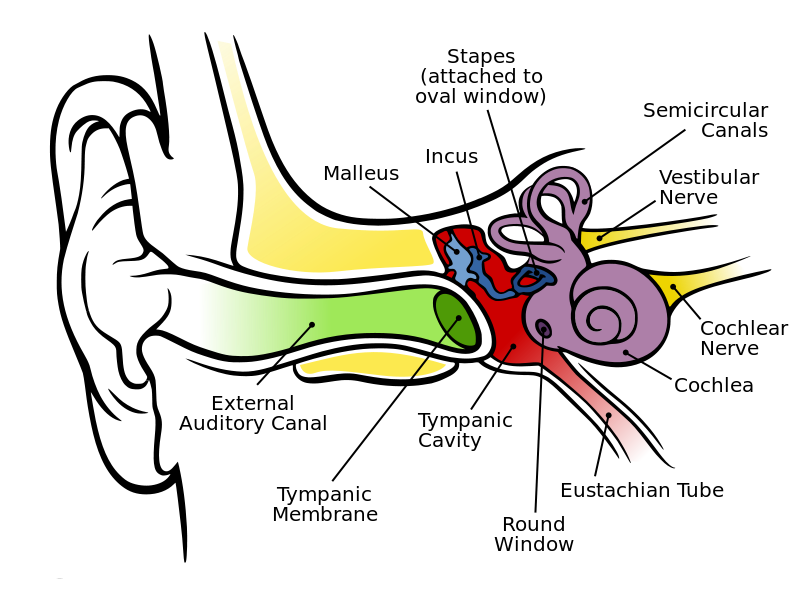
The sense of hearing depends upon the vibration of sound waves on the thin membrane called the tympanum or eardrum, which in turn vibrates in turn each of the 3 bones of the middle ear, the malleus, incus and stapes, commonly called hammer, anvil and stirrup. The last bone activates tiny hairs which send a nervous impulse to the brain.A. Orienting to Sound: First, have a blindfolded subject try to point to a ticking object like a clock or a kitchen timer while their head is in a fixed position. Then allow them to turn their head while trying to identify the source of the sound. Which is more effective - turning the head or staying still? Why? Why is it harder with an earplug in one ear? How do animals that can turn their ears have a further advantage?
B. Balance: Balance or equilibrium is controlled by the semicircular canals of the inner ear. Each of the three canals is oriented along one of the 3 dimensions of the body (the x, y and z axes), so motion in any direction is felt when the fluid inside the canals triggers tiny hairs on the inside. The brain integrates this information into a sense of balance.
C. The Doppler Effect: Near a busy street or highway where cars are moving at a steady speed, close your eyes and listen as cars approach, pass you, and then move away. The sound of the car will have a higher pitch as it is approaching and, as it passes and moves away, the pitch should drop. This happens because the sound waves are closer together on approach because the car is chasing its own sound waves. The faster the vehicle is moving, the more pronounced this effect will be. After the car passes, the sound waves are farther apart because the car is retreating from its sound waves. When a vehicle moves fast enough (the speed of sound is 768 mph) to catch up to its own sound waves, a sonic boom occurs because the sound waves produced earlier are added to the ones produced now.i. Balance and Vision: Have a person stand on both feet without moving while their eyes are closed. Then have them balance on one foot with their eyes closed. Finally have them walk a straight line with their eyes closed. How does vision work in concert with the sense of balance? Can you see why people are asked to walk a straight line to test sobriety?
ii. Proprioception: How is it that, even with your eyes closed, you know whether your arms are extended directly in front of you, up over your head or down at your side, bent at the elbow or straight, with palms facing up or down? Do you think this is affected by gravity or not? Would an astronaut in zero gravity and in pitch darkness know? Can you touch your nose with your eyes closed?
iii. Motion Sickness: Motion sickness is generally caused when the inner ear and the eye disagree about the status of the body. For example, when you are in a smooth riding car and you look out the window, your eye tells you that you are moving rapidly while your inner ear says you are sitting still. In a way, both are true, but the brain can't rationalize these two different experiences and it results in nausea for some people. Why does staring at a fixed point on the horizon rather than the fast moving terrain sometimes help to reduce motion sickness? Why is zero gravity nausea inducing for most people?