Felt-tip pen chromatography
Introduction:
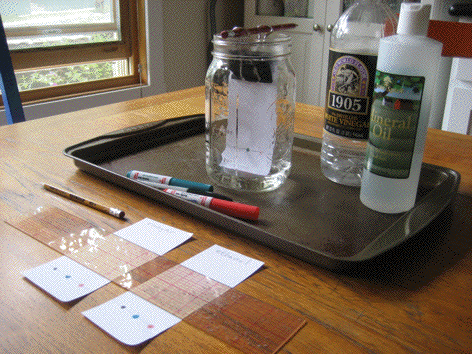
Lab Setup
This lab will help you understand what you've read about the properties of molecules including acidic and basic molecules, polar and non-polar molecules. Chromatography is a technique used widely in chemistry and in the biological sciences for: 1) separating mixtures of compounds, and 2) to identify unknown substances. All types of chromatography employ two different immiscible (non-mixing) phases in contact with each other. One of the phases is moving, the mobile phase, and the other is not, the stationary phase. In paper chromatography, for example, a solvent (the liquid) moves from one end of a piece of paper to the other end, as the paper absorbs it. The solvent is the mobile phase because it is moving, and the paper is the stationary phase. Mystery chemicals dissolved in the water are carried along in the mobile phase but drop out at different points along the way. Watch this video, or this one, for an overview of the process.
A mixture of chemicals can be separated using paper chromatography. A small amount of mixture to be separated is placed near the edge of an absorbant paper. That edge of the paper is wetted with solvent. The solvent travels up the paper by capillary action, carrying the mixture with it. Separation occurs because different chemicals in the mixture travel different distances, depending upon whether they have a stronger attraction for the mobile phase, the solvent, or for the stationary phase, the paper. When the solvent has moved the entire length of the paper, the paper is removed from the solvent and dried. Once developed, the paper, called a chromatogram, will contain different chemicals located at different positions on the paper. The color and location of each compound can be used as a basis for identification because it can be matched with the color and location of known compounds subjected to the same conditions.
In this lab you will use the technique of paper chromatography to separate the colored dyes in felt-tipped pens, and state why you get the results you obtain. (Option: If you wanted to make this lab more "biological" you could try plant pigments instead. Separately blend up some mint leaves, some carrot, and some red cabbage leaves and use the green, orange and red juices instead of marker dyes. You might need to use a different solvent, such as acetone (nail polish remover) or alcohol.) See this video: https://www.youtube.com/watch?v=qH-AJDqsSII
Materials:
- chromatography paper or filter paper (substitute coffee filter paper cut into strips for good results; rate of the solvent movement will depend on the type of paper)
- solvents (use distilled water and at least one other solvent such as vinegar, wood alcohol, rubbing alcohol, or acetone (nail polish remover) and compare results). Be sure to use the acetone in a well ventilated space.
- Safety Warnings: While ethanol is the alcohol people drink, 99% ethanol is purified by a toxic chemical process! Other alcohols such as methyl (rubbing) alcohol are poisonous. Never drink laboratory alcohol! Acetone vapors are flammable and can make you sick. Use in a well ventilated space.
- wooden skewer or pencil, metric ruler, binder clips
- colored marking pens, water soluble (washes off with water or dry erase) and permanent
- battery jar, mason jar, or clean spaghetti sauce jar (any tall glass jar with a wide mouth)
Procedure:
- Cut a piece of filter paper so that the bottom edge is straight and the paper will fit into a tall glass jar without the sides of the paper contacting the jar.
- Make the filter paper just tall enough so that the paper can be suspended from a pencil or ruler placed atop the jar, and the bottom of the paper stops just short of touching the bottom of the jar.
- Label each piece of filter paper with pencil, indicating which solvent you are using. Pencil marks won't fade or drift.
- Make a horizontal pencil line about 2 cm from the bottom of the filter paper. Place light pin points of ink from dry erase markers about one to two centimeters apart across the pencil line on the filter paper. Label each mark with pencil.
- Repeat this procedure with a second piece of filter paper on which dots of permanent marker ink are placed.
- Add the solvent to the jar(s) to a depth of about 1 cm. You will need two filter papers for each jar of solvent.
- Carefully lower the filter paper with the marker ink dots, secured with tape or a binder clip to a pencil, wooden skewer or ruler, into the jar with bottom edges just barely submerged in the solvent. Ensure that the bottom of the paper is, but the marker dots are not, in direct contact with the solvent!
- Allow the solvent to creep up the paper (elute). This will take about 15 minutes, but may take longer depending on the solvent and paper type. Be sure to remove your chromatography paper from the solvent once it has reached one to one half cm from the top. Do not allow the solvent to reach all the way to the top of the filter paper!
- Hang the chromatograms and allow them to fully dry before making measurements.
- Clean up. Run the solvents down the drain with lots of tap water.
Results:
Close up of a chromatogram.
In the chromatogram shown above, the paper used was a standard coffee filter, cut into a rectangular shape. The solvent was water, and the inks used were from highlighter pens, using yellow, pink, blue and green pens. Recall that the color green can be made by mixing blue and yellow, and that the green ink has separated into its constituent parts. However, the yellow component moves higher and the blue component is left behind. Are the blue and yellow inks the same as the pure blue and pure yellow?
Calculations:
In chromatograpy, the symbol Rf is used to denote the position of a dissolved component on a chromatogram relative to the distance the solvent moved. This Rf value is a quantitative reflection of the physical interaction of each component with the mobile phase (the solvent) and the stationary phase (the paper).
Rf = Dp / Ds
Rf = distance pigment moved / distance solvent moved
Measure the distance from the origin of the marker dots (the pencil line) to the center of the eluted marker ink. Divide that number by the distance the solvent moved, ie. from the origin to the solvent front. The best way to estimate the center of a non-circular spot is to draw the best elllipse around the spot and estimate its center. Create a data table for Rf values on each of your inks tested. Clearly indicate whether the ink was from a wet erase pen or a permanent marker.
Questions:
- What happens to the ink spots as the chromatogram develops? Why?
- If one dye moves more rapidly than another, which one dissolves more readily in the moving solvent?
- Which of the ink dyes that you used are probably made up of only one compound? How can you tell? Which are made up of more than one compound? Why?
- How can you tell if two different brands of pens use the same combination of dyes to make black, blue, or another color?
Error: Discuss any possible sources of error in this laboratory investigation.
Further Investigations:
Design further experiments whereby you would try to obtain a more informative chromatogram of the permanent marker pens. What procedural or material changes could you make?
Design a procedure whereby you possibly could identify the dye types used in the marker inks tested.