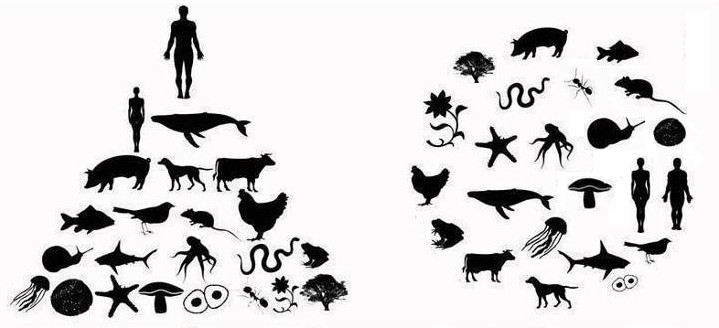
Better not to think of life as a hierarchy of superior and inferior forms but, rather, as a branching bush of great diversity, all derived from the same root.
Sorting things is human nature:
The science of Taxonomy, or the classification of living things, is as old as humanity. People have always found it necessary to be able to organize and identify the living things that are a part of their daily lives. Native American legends actually teach us a great deal about the true natural history of the North American continent. In one primitive tribe in the South American rainforest, the classification of medicinal plants and insects was more detailed than that of the modern day biologists who had come to study them with all the tools of 20th century technology!
History of Classification:
From the time of Plato and Aristotle, it was believed that all life could be organized from most primitive to most advanced along a "Great Chain of Being." The most primitive forms of life were placed at the bottom of the hierarchy, while humans resided on the top (royalty above commoners, men above women, white men above men of other races--the vanity of the aristocratic white men who developed the system is clearly visible!), closest to God. We now know that a true classification system for the diversity of life is more like a branching tree than a stairway to perfection. Plants are not inferior to animals, for example, but have simply taken a different strategy towards survival. All organisms alive today are successfully adapted to their respective environments, since they have stood the test of time. In fact, there are even some extinct forms, like the trilobites and the dinosaurs, that lived for so long that you could hardly call them failures. Humans are relative newcomers to the Earth, and we will be lucky if we last that long! You may occasionally hear biologists refer to "primitive" and "advanced" forms of life, but this terminology conveys a value judgment and is, therefore, to be avoided. Better to speak of ancestral (little changed from earlier forms) and derived (more changed) traits or species. After all, is an organism "primitive" if it is so well suited to its environment that it has remained virtually unchanged for hundreds of millions of years? Sharks are "primitive" cartilagenous fishes, but they feast on a diet of more "advanced" bony fish.
Better not to think of life as a hierarchy of superior and inferior forms but, rather, as a branching bush of great diversity, all derived from the same root.
A Classification System:
The first person to formalize the classification of living things was Carl von Linnae, also known as Linnaeus (the Latin form), who lived during the 1700's (about 100 years before Darwin). Although his methods were simple and have been expanded upon, some elements of that system are still in use today. Linnaeus' method of classification was based on similarities and differences; a logical place to start. He began by dividing all the organisms he knew of into separate Kingdoms based on the greatest physical similarities and differences. Subdivisions within Kingdoms were called Phyla. Phyla are subdivided into Classes. Classes are subdivided into Orders. Orders are subdivided into Families. Families are subdivided into Genera. Finally, the Genera are subdivided into species. Each species is defined as a group of organisms with the potential to interbreed. Members of different species cannot, by definition, mate and successfully produce fertile offspring. All names are written in Latin, because this is a "dead language" - it never changes and is used only by scientists. The scientific name of an organism is written as Genus species, sometimes shortened to G. species. By convention, the genus and species names are either italicized or underlined. Genus name starts with an Uppercase letter while species name starts with a lowercase letter. Here are a few examples:
|
Common Name |
Chimpanzee | Blue Jay | Honeybee | Nightcrawler | Sea Urchin | Octopus | ||||
|
Kingdom |
Animalia |
Animalia |
Animalia |
Animalia |
Animalia |
Animalia | Animalia | Animalia | Animalia |
Plantae |
|
Phylum |
Chordata |
Chordata |
Chordata |
Chordata |
Chordata |
Arthropoda | Annelida | Echinodermata | Mollusca |
Tracheophyta |
|
Class |
Mammalia |
Mammalia |
Mammalia |
Aves |
Actinopterygii |
Insecta | Clitellata | Echinoidea | Cephalopoda |
Angiospermae |
|
Order |
Primata |
Primata |
Carnivora |
Passeriformes |
Salmoniformes |
Hymenoptera | Haplotaxida | Echinoida | Octopoda |
Asterales |
|
Family |
Hominidae |
Hominidae |
Felidae |
Corvidae |
Salmonidae |
Apidae | Lumbricidae | Strongylocentrotidae | Octopodidae |
Asteraceae |
|
Genus |
Homo |
Pan |
Lynx |
Cyanocitta |
Salvelinus |
Apis | Lumbricus | Strongylocentrotus | Octopus |
Helianthus |
|
species |
sapiens |
troglodytes |
lynx |
cristata |
fontinalis |
mellifera | terrestris | droebachiensis | vulgaris |
annuus |
The Linnean system of classification sorts living things into smaller and smaller categories based on similarities and differences.
Modern Interpretation:
The Linnean system is still used to categorize living things, but we now accept that the levels of organization from Kingdom down to species are somewhat arbitrary. Physical comparisons are often effective at identifying relationships between species, but they can sometimes be misleading. Sharks, dolphins, and penguins are not closely related, but all have converged on a streamlined body form because they swim through the water. Dolphins and dogs, at first glance, don't appear to be very closely related, but they are both mammals and are therefore much closer relatives than dolphins and sharks. Adding what we know from DNA comparisons helps us to check our conclusions made from physical characteristics. Physically, humans are most similar to the great apes; the gorillas, chimpanzees and oragutans. We know from DNA analysis, however, that our closest living non-human relatives are the chimpanzees; approximately 95% of our DNA is identical to theirs.
Kingdoms:
So how many major divisions, or kingdoms, of living things are there? In elementary school, we learned about the differences between the Plants, which are green and make their own food, and the Animals, which move around and ingest their food. The Fungi, quite distinct from the plants, gain nutrition by absorption, so we have a third kingdom. Then, to take microorganisms into account, two more kingdoms, the Protists (the complex unicellular forms) and Monerans (the primitive single celled forms) are added.
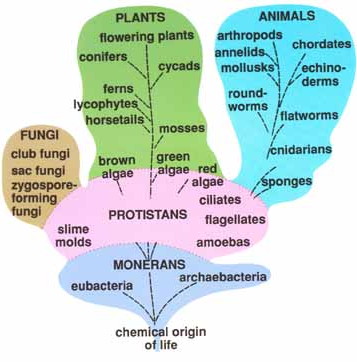
The five kingdom system of classification.
While this system of organization is reasonable, it contains a bias. In reality, the plants, animals, fungi, and protists are all more similar to each other than any are to the monerans, so one could argue that a better division is between the simper Prokaryotes (the Monerans) and the more complex Eukaryotes (which are then subdivided into Protists, Fungi, Plants, and Animals). That sounded good until the Archaebacteria were discovered, and it turned out that they are as distinct from the rest of the Prokaryotes as the Prokaryotes are from the Eukaryotes! Thus, we end up with a three kingdom system, though, as you can see below, it gets even messier: The Archebacteria (blue), the Eubacteria (green), and the Eukaryota (red). And then there are the viruses which, depending on your definition, may not even be considered living; at least not on their own. While it may seem odd to us that we are grouped in the same kingdom of living things, not just with our furry friends but, with mushrooms, algae, earthworms, and slime molds, it just tells you how much more different the members of the other kingdoms are. We continue to discover new groups of these extremely bizarre life forms of the Archaebacteria in hot springs and deep sea thermal vents near the boiling point of water. It is possible that these are the most ancient of organisms and that they remain little changed from the early days of life on earth.
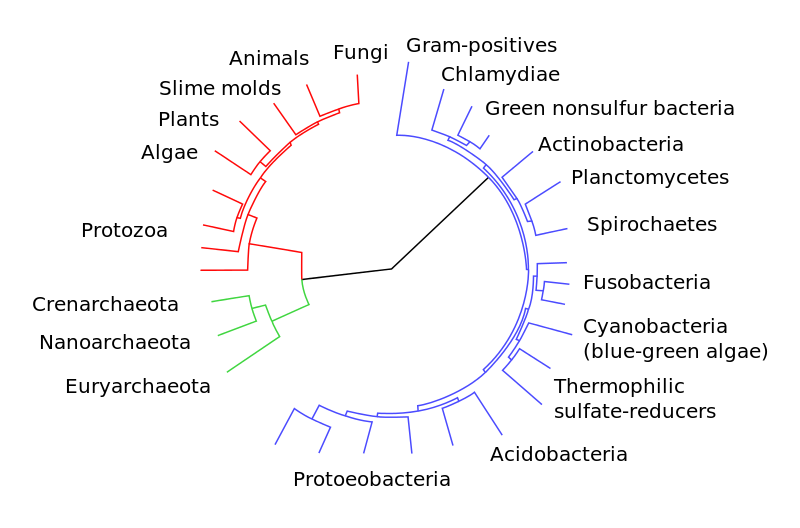
The three kingdom system of classification.