Final
Examination and Task Stream for
ESE 425
To complete
this assignment successfully, you will be required to complete the final exam as well as being involved in a signature assignment on TaskStream, NAU's Electronic Portfolio.
- Go to the Northern Arizona University Electronic Portfolio TaskStream site.
- The url is https://www.taskstream.com/pub/
- Complete the assignment.
- You may choose to send your assignment to the professor as a draft. You will get useful feedback if you wish.
- Submit the
assignment in your personal portfolio account and send confirmation to the professor that you have submitted the final.
- Collect
a
 for completion. You made it!
Field Project and ESE 425 Final: Functional Behavioral Assessment
Rubric
Functional Behavioral Analysis
Task Stream
Focus: The FBA is a similar process to the child study team. You are looking for a way to understand why a child is behaving in a way that is keeping him or hear from learning and interfering in some significant way with the teacher's instruction and a sense of community.
Directions for Target Score |
Product |
The candidate obtains data through indirect and direct means. The data is clearly summarized and expressed. The candidate includes demographic information, type of class, classroom environment, student information, instructional delivery, class management style and when appropriate interviews of staff, student, parent(s), etc. a school file review. The candidate uses multiple resources and grounds data with outside sources. |
Story of student – clear, concise, spelled out
Type of class
Environment of class specified (teacher
behavior, way it is structured, rules students are
held to and discipline expected
How instruction is delivered
Tell that you reviewed student files
Describe talking with current teacher about the child
Describe talking with previous teachers or aides
Describe talking with the parents about the child
Describe talking with the child |
The candidate defines behavior in clear, observable, concrete terms and adds rationale for choosing the behavior. |
Behavioral objective
Measurable
Concrete |
The candidate's data expresses critical elements. The candidate's charting includes the following pertinent information: ABC charts, anecdotal assessment charts, detailed procedures of data collection, frequency, intensity, duration, antecedents, names behavior, setting, time of session, consequence, patterns and behavior across time and settings. The candidate provides a foundation for the baseline data by relating it to the text, discussion and outside sources. |
Do and include several charts
ABC chart
Anecdotal assessment
Baseline
Detail how you collected data (hours spent, times observed; include intensity, duration, settings and amount of time in them
Summarize how smart you were to do it this way and why it worked to give you good data about the student
Add a smug touch about something you found because of your tenacity or extra step, looking for clues |
The candidate's analysis includes events across time and in other environments. The candidate has a clear interpretation of ABC, connects the reinforcer to the behavior and justifies analysis by referencing additional resources. |
Do an analysis of the behaviors and why the student is doing them (antecedents – what sets up the behaviors that are being observed); and then discuss what basic needs may be is reinforcing the student. Include things done by the teacher and by peers.
Keep it simple. Come up with no more that a cluster of three – prefer staying with one, i.e. time on task or sharpens pencil during instruction
PUT IN TWO references that justify your findings and use APA referencing to do it. |
The candidate shows a clear understanding of the behavior based on data, connects the reinforcer to the behavior, formulates a sound, clear, and concise hypothesis with other facts, resources and citations. |
Develop a great hypothesis
Include why the student is misbehaving
Trace how you came to this explanation of why the
student is misbehaving, based on observations,
ABC charts, etc.
Cite two references for why (yes, use APA style) |
Behavior Intervention Plan
Task Stream
Directions for Target Score |
Product |
The candidate states the function of undesired behavior which is based on data from the FBA. The candidate demonstrates a clear understanding of the purpose of the behavior and provides examples and interpretation. |
This is basically a nice summary of everything you just did in the FBA. You are going to show (document) that you went to all that work and have reasons to do BIP |
The candidate states and clearly defines the behavior to be taught. The candidate lists specific conditions of appropriate application through a teaching sequence. |
Define behavior(s) once again. Use a behavioral objective – yes, the same one you already wrote.....
Now you get very specific about how you introduce this to the student, set the class up to succeed in helping with the reinforcement and continue to teach and support the student as you carry out the behavior change process. |
The candidate takes a comprehensive look at the environment and describes it. The candidate analyzes, identifies and recommends strategies to remove barriers and lists solutions. Actions are clearly defined. |
As you implement the change, there will be barriers or ways the student thwarts your efforts. You will discuss the valiant strategies you come up with the continue the change and get that objective met. |
The candidate details the type of reinforcement used. The candidate includes a detailed schedule that takes in to consideration prompts, cues, and pre-correction over time. Consideration is given to the beginning of plan and long term strategies of reinforcement. |
Charts go here. These are the ones that match the baseline, but go on for weeks.
Show: prompts, cues, pre-correction, support, and remember this is for a number of weeks |
The candidate states clear consequences for instances of problem behavior, establishes a distinction between outcomes for the replacement behavior as opposed to the consequences of problem behavior. |
Explain that the student was not immediately successful and how smart you were in finding new ways to overcome resistance.
Include examples of replacement behaviors you developed and consequences you came up with to help the student change. |
The candidate develops a concise means to determine success of replacement behavior. The candidate's data collection methods best matches the settings in which the BIP will be implemented and charted. The candidate considers the decrease of target behavior and the increase of replacement behavior. |
Charts again! Show that you had trouble at first, but over time, the target behavior decreased and the student replaced it with _____________________ |
The candidate writes specific behavioral goals and objectives for the student with ELN, under which the behavior will be measured and the criteria for success. The candidate also provides standards for evaluating including frequency, duration, and/or intensity of the target and assurance that replacement behaviors have met objective criteria for success. |
Restate the behavioral goal and objectives and be sure you have included criteria for success
Explain how you evaluated the change, including frequency, duration and intensity as matched by your charting
Explain what a great success you have with the replacement behavior and say again how this succeeded in getting the change and still meeting the student's needs. |
ESE 425
Integration and Synthesis
Assignment: FBA and BIP
Directions:
• Review the following information about the FBA, BIP and Manifest Determination process.
• Identify one youngster with whom you are working who has an FBA and/or BIP in place. Using the proper protocol and privacy requirements, access his or her file and review the documents.
• Interview the special education teacher who is working with the youngster.
• With proper permission, spend a minimum of 3 hours observing the student and documenting the current plan and its strengths and weaknesses.
• Based on your findings, develop an FBA and BIP for that youngster.
• Turn in the assignment and then once graded, place the material in your portfolio, using taskstream.
Looking out for the needs of the individual |

|
Looking out for the needs of the group |
This is a model of what the law IDEA 2004 (effective July 1, 2005) and IDEA 2004 federal regulations (effective October 13, 2006) asks us to do.
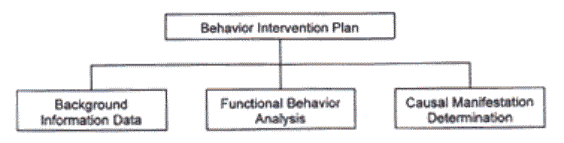
Remember, this model can be used at any time. A BIP and FBA are useful processes for thinking about behaviors that prevent a child or the classroom from effectively learning and working. They help the teacher and the student systematically improve.
If a student who meets criteria in the IDEA law as ED, the school is mandated, BY LAW, to hold a manifest determination before the student is suspended.
Manifest Determination |
Suspension |
The manifest determination hearing, an IEP team meeting, occurs after a child with a documented disability is recommended for suspension. An alternative educational setting (AES) may be requested. ..for certain drug and weapons offenses or inflicting serious bodily injury at school. |
Expulsion |
Before expulsion can be initiated for a student with a disability, the IEP team must conduct a "manifest determination." In this meeting they must determine whether the behavior exhibited by the student that resulted in expulsion was: 1) a result of the disability; 2) a result of the school not implementing the IEP and behavior plans adequately. The MD hearing must occur within twenty (20) school days after the decision was made to recommend an expulsion. The final decision must be made by ten (10) school days after the hearing. The law no longer states that the child continues to “stayput” |
Disagreement |
If the student's parents disagree with the manifest determination meeting decision, a due process hearing can be requested from a panel outside of the basic IEP team. This centers on the question of whether the child's disability led to the behaviors. If yes, the child cannot be expelled. If no, the school can terminate services. |
The Process
• Background Information – Look in records and ask parents, the nurse, other teachers, the child --
• The FBA piece --Is the behavior problem real? Document and establish the antecedents, the frequency, the seriousness of the problem.
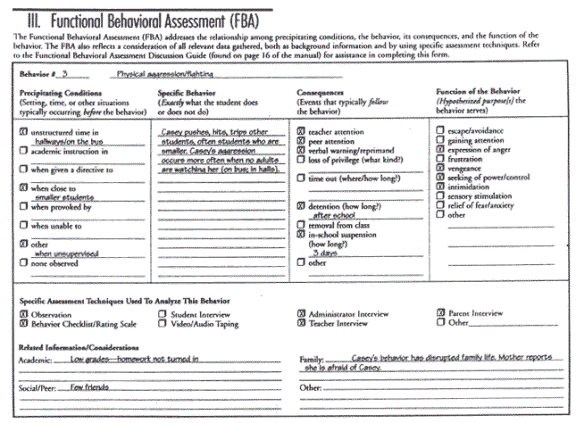
Identifying the reasons for behavior will take many forms, and while the IDEA advises an FBA approach to determine specific contributors to behavior, it does not require or suggest specific techniques or strategies to use when assessing that behavior. However, several key steps are common to most FBAs:
• Verify the seriousness of the problem.
• Define the problem behavior in concrete terms.
• Collect data on possible causes of problem behavior.
• Analyze the data.
Formulate and test a hypothesis.
3. Causal determination – Hold a meeting to get agreement about the findings.
 You will not do this step during the assignment, since it may be invasive. In the future, you will include this crucial part of the process. You will not do this step during the assignment, since it may be invasive. In the future, you will include this crucial part of the process.
4. Developing the Behavioral Intervention Plan
The following is a very good link to review behavior management concepts.
http://www.ldonline.org/ld_indepth/behavior/behavioral_intervention.html
Once the FBA, observations and manifest determination steps are completed it is time for the BIP.
• Review of the behavior targeted in the functional behavioral assessment.
• Determination of behavioral goals that relate to increasing or decreasing the specific behavior.
• Determination of the specific intervention strategies appropriate for the behavior. Designation of the individual (or individuals) responsible for implementing the plan.
• Determination of the appropriate dates for review of the plan and evaluation of its success.
• Determination of the appropriate methods for evaluation of the plan. Fad (1998)
Links to excellent sample forms:
http://www.mfba.net/forms.html
http://fifa.fmhi.usf.edu/schoolforms.htm

Charts from:
Horner, R. H, O'Neill, R. E., Albin, R. W., Sprague, J. R., Storey, K., Newton, J. S. (1997) Functional assessment and program development for problem behavior: A practical handbook. Pacific Grove, CA: Brooks/Cole.
The seven step plan is used to analyze a student behavior or set of behaviors.
1. Identify the problem behavior.
2. Define the behavior clearly in observable terms.
3. Observe the student in the setting.
4. Identify antecedents for student misbehaviors
5. Look for or ask about the needs being fulfilled or the student motives.
6. Identify replacement behaviors that are likely to fulfill the student needs.
7. Develop and implement an intervention plan as a team.
Field Project and ESE 425 Final: Functional Behavioral Assessment
You will go into the field and conduct an interview and observation. You will interview staff members (i.e. teachers, administrators, para- professionals…) and conduct an initial observation in order to target several behaviors that are impeding learning in the classroom or for an individual student. In a collaborative effort you will prioritize those behaviors. This will lead you to identify a single target behavior. At this stage of your project you will:
1. Define the target behavior in observable and concrete terms.
2. Set up the observation focusing on direct and indirect methods of gathering information. Answering questions like “Who could I have asked and what other resources could I have used to gain a clear picture of the behavior I am observing and why”(indirect) … or… “what staff and other resources have I used in order to set up my observation and understand possible causes of problem behavior” (direct).
3. You will gather baseline data by using appropriate strategies such as ABC charts and procedures. Include any raw data recorded on the data sheet with your project. Provide any explanation and/or keys. (TI =trial one)
4. You will analyze the data. Think about what you have observed; Is there a pattern? What happens across settings? What is the antecedent, consequence (reinforcer)?
5. You formulate a hypothesis as to why the behavior is occurring.
DUE:
Upon Completion of 2,900 points or the first six doors/modules that comprise
the basic course.
/ESE 425 Classroom Management
|
Assignment : Final Signature Assignment
Functional Behavioral Assessment |
SPA/Discipline Outcome Code |
SPA/Discipline Outcome |
Approaches |
Meets |
Exceeds |
CC5K1
Demands of learning environments.
CC5K5 Social skills needed for educational and other environments . CC8S1Gather relevant background information . |
Initial observation and interview
20% |
Provides minimal summary of the experience , could be more clear ideas and observations not related to FBA, lacks specifics pertinent to the development of target behavior |
Summarize your experience in the classroom, including your observations of behaviors and grade level instructional delivery, classroom management, student behavior, physical environment, staff interviewed and their back ground information, |
Summarize your experience in the classroom, including your observations of behaviors and grade level instructional delivery, classroom management, student behavior, physical environment, staff interviewed and their back ground information, makes reference to text or in class discussions. |
|
Target behavior
20% |
Description of target behavior is weak lacking objectivity, use of reactions and interpretations cloud description of target behavior |
Defines target behavior in observable, concrete terms |
Defines target behavior in observable, concrete terms, adds rationale for picking the behavior |
|
Baseline data
15%
|
the data lacks critical elements, minimal criteria on chart |
Data expresses critical elements, use of chart includes pertinent information uses appropriate strategies such as ABC charts and procedures of d ata collection, I includes frequency, intensity and duration antecedents, pertinent information, name behavior, setting time of session consequence, patterns
|
Data includes frequency, intensity and duration antecedents, consequence clearly defined, charts complete with additional information, time setting people involved pertinent information, names, behavior, setting time of session consequence, patterns, resources text, prior resources
|
|
Analyze the data .
20% |
No connection is made between the data and target behavior |
Analysis includes events across time, in other environments, clear interpretation of ABC and connects the reinforcer to the behavior. |
Analysis includes events across time, in other environments clear interpretation of ABC and connects the reinforcer to the behavior justifies analysis by referencing additional resources. |
CC5K2
Basic classroom management theories and strategies for individuals with exceptional learning needs. |
Formulate hypothesis
25% |
Hypothesis is not related to the data and shows minimal or no connection to data, a lack of understanding of the behavior. Lack of data, interferes with the abililty to formulate a hypothesis |
Shows a clear understanding of the behavior based on data, and connects the reinforcer to the behavior and formulates a clear and concise hypothesis. |
Shows a clear understanding of the behavior based on data, and clearly connects the reinforcer to the behavior and supports hypothesis with other facts and resources |
|
Score
100% |
|
|
|
|
|
|
|
|
FINAL Assessment Rubric
Summary
Score |
Knowledge/Skill
Indicator |
Unacceptable (1) |
Acceptable (2) |
Target (3) |
|
CEC Standard # 5 and #8
CC5K1, CC5K5, CC8S1 |
Teacher candidates demonstrate an inadequate knowledge base in the foundations of special education. |
Teacher candidates demonstrate the knowledge base in the foundations of special education. |
Teacher candidates demonstrate an in-depth knowledge base in the foundations of special education through reflection, critical analysis, and synthesis |
|
|
|
|
|
|