The mission of The Center for Excellence in Education at
Northern Arizona University is to prepare education professionals to create the
schools of tomorrow.
NORTHERN ARIZONA
UNIVERSITY
Center for
Excellence in Education
EPS 325
(Educational
Psychology for Secondary School)
Summer Session II
2002
General
Information
|
Instructor: Dr. John R. McClure |
Phone: 523-0578 |
|
Office: 154 Eastburn |
e-mail: john.mcclure@nau.edu |
|
Office Hours: Monday through Friday 11:00 AM - 12:00 Noon |
Class times: Monday through Friday 1:00-2:45 PM |
Course
Description
The purpose of this course is to provide prospective teachers with an understanding of learning as a psychological process. Such an understanding is crucial and will serve as the theoretical base for making informed decisions about the planning, presentation and assessment of instruction in your own classrooms.
Course
Objectives
At the conclusion of this course, you will be able to:
1. Discuss cognitive learning theory in terms of the information processing system and cognitive processes as they relate to learning.
2. Describe, identify and categorize types of learning outcomes from the perspective of cognitive learning theory.
3. Apply cognitive learning theory to the design of instructional activities.
4. Describe human behavior and interactions from a behaviorist perspective.
5. Describe and discuss motivation as a psychological construct affecting learning.
6. Apply theories of learning and motivation to the development of classroom management plans.
7. Apply theories of learning and motivation to analyze teaching practice.
Course
Structure
Class sessions will typically follow a lecture discussion format; however, when appropriate other formats, such as small group discussions will be utilized.
Readings and
Required Text
Required Text: Woolfolk, Anita E. (1998). Educational Psychology: Merrill/Printice Hall, Columbus, OH
Additional Readings will be placed on reserve in the
Curriculum Lab
Course
Requirements
Class attendance and participation are required. In this class you are expected to practice the professionalism and responsibility that is expected of working teachers. Consequently attendance will be handled in a manner consistent with standard work practices (that is to say, coming to class is just like showing up for work). If you are absent for any reason, I expect that you will communicate that reason to me in a timely fashion. When possible you should notify me in advance of any absence. I prefer that you communicate via e-mail (john.mcclure@nau.edu). You are responsible for the material covered on any missed days and any unannounced quizzes missed as the result of an absence may not be made up. Scheduled examinations missed for appropriate documented reasons will be made up without penalty. Participation is defined as relevant and consistent contribution in a manner appropriate for a future teacher. I reserve the right to consider your attendance and participation patterns when assigning final grades.
Readings: The assigned readings are to be completed prior to the class period for which they are assigned. While the class lectures and discussions will not duplicate the reading assignments, familiarity with the concepts from the readings will facilitate your comprehension of lecture material and enhance your potential for class participation.
Assignments: Participation in this course includes completion of a variety of assignments. Preparation and participation in these assignments is an integral part of the learning experience and also serve as a basis for your performance evaluation.
Scheduled Examinations. There will be three scheduled examinations (two mid-term exams and a final examination). These exams will be multiple choice and will cover material from class lectures, discussions and assigned readings. All examinations will be cumulative.
Participation Activities. These short quizzes and classroom activities will be unannounced and administered during class to assess your understanding of concepts discussed in class or presented in the assigned readings. There will be approximately 8 quizzes and 7 participation activities. These activities may not be made up; however, in the case of an absence for an appropriate cause, the student's overall grade will not be penalized. In the case of an inappropriate absence, the activity will be scored as a zero.
Course Policies
1. Both mid-term examinations and the final examination will be given on the dates shown in the schedule below. Examinations may not be made up or rescheduled except in the cases of documented illness or family emergency.
2. Participation activities may not be made up.
3. In the event of an unusual final point distribution, the final point requirements may be lowered. This will be solely at the discretion of the instructor.
4. Academic dishonesty includes plagiarism, cheating on tests, or lying about work involved in class. The policies in the NAU Student Handbook apply to such situations.
Evaluation
Methods
Grading: Grades will be awarded based on the percentage of possible points attained by each student. In cases where a student's accumulated point total is close to the cut-off between letter grades, I will use class attendance and participation to make a determination of the final grade. Students may earn points as follows:
|
Activity |
Points |
Date
Due/Scheduled |
|
Mid-term Examination 1 |
50 points |
7/16 |
|
Mid-term Examination 2 |
75 points |
7/25 |
|
Final Examination |
100 points |
8/7 |
|
Quizzes |
5 points x 8 = 40 points |
To be announced |
|
Classroom Activities |
5 points x 7 = 35 points |
To be announced |
|
Total Possible |
300 points |
|
The final grades will be determined based on a percentage of the total possible points as follows: A = 90% to 100%, B = 80% to 89%, C = 65% to 79%, D = 55% to 64% and F æ 55%. In the event of an unusual final point distribution, the final point requirements may be lowered. This will be solely at the discretion of the instructor.
Topics, Readings
and Tentative Due Dates
The list of topics, scheduled below, is tentative. The instructor reserves the right to modify the schedule based on contingencies that may arise as the semester progresses.
|
Date |
Topic, Reading Assignments and
Objectives |
|
7/8 |
Course Introduction: Psychological Research and Educational Practice Reading: Text, Chapter 1, pp. 3-20 Objectives: - know the characteristics of psychological theories relevant to teaching and learning, - understand the role of research in education and - understand the nature of educational research. |
|
7/9 |
Evaluation in Educational Research and Practice Reading: Text, Chapters 4 and 14 Objectives: - understand the types of observations used to evaluate teaching effectiveness, - understand statistical concepts used to interpret observations, - understand ≥reliability≤ as a characteristic of an assessment, - understand ≥validity≤ as a characteristic of a decision, - apply the concepts of validity and reliability to issues of evaluation in education, - understand the issues of reliability in assessing individual differences, - understand the issues of the validity of decisions based on group data and - understand the relationship between individual and group differences in learning ability. |
|
Date |
Topic, Reading Assignments and
Objectives |
|
7/10 |
Development and Instruction Reading: Text, Chapters 2 and 3 Objectives: - know the definitions of key concepts of Piagetπs theory of cognitive development, - know the key concepts of Vygotskyπs theory of cognitive development, - know the implications of theories of cognitive development for educational practice, - understand the implications of the stages of Eriksonπs theory of psycho-social development, - understand the implications of the three possible identity states, - understand the relationship between Kohlbergπs theory of moral development and cognitive development and - understand the issues related to the development of children. |
|
7/11 |
Introduction to Behavioral Learning Theory Reading: Text, Chapter 6 Objectives: - know the definitions of key concepts of behavioral learning theory, - understand classical and operant conditioning, - understand the effects of various reinforcement schedules, - know the ABAB design for researching behavioral change, - understand behavioral techniques for encouraging desired behavior, - understand behavioral techniques for discouraging undesired behaviors and - analyze classroom situations from the perspective of behavioral learning theory. |
|
7/12 |
Behavioral Modification: Classroom Issues Readings: Text, Chapter 6 and Chance, P. (1992). The Rewards of Learning. Phi Delta Kappan, June, pp. 787-790 Kohn, Alfie (1993). Rewards versus Learning: a response to Paul Chance. Phi Delta Kappan, June, pp. 784-785 Chance, P. (1993). Sticking-Up for Rewards. Phi Delta Kappan, June, pp. 787-790 (On reserve in the curriculum lab) Objectives: - understand the correct use of reinforcers, - understand the hazards of the improper use of reinforcers and - understand the implications of behavioral learning for instruction. |
|
Date |
Topic, Reading Assignments and
Objectives |
|
7/15 |
Introduction to Social Learning Theory Readings: Text, Chapter 9, pp. 321 - 329 Objectives: - know the types of observational learning, - understand the elements of observational learning, - understand the factors that affect observational learning, - understand the role of self-regulation and self-management in learning and education, - know and understand the elements of self-management and - understand the application of social learning theory to classroom instruction. |
|
7/16 |
Examination 1 |
|
7/17 |
Introduction to Cognitive Learning Theory Reading: Text, Chapter 7, pp. 239-244 Objectives: - understand the differences between cognitive and behavioral views of learning, - understand the cognitive view of knowledge and - know the elements of an information processing model. |
|
7/18 |
Sensations to Perceptions in the Information Processing Model Reading: Text, Chapter 7, pp. 244-246 Objectives: - know the capacity, duration and contents of sensory memory, - understand the role of attention and perception in the information processing model, - understand the difference between bottom-up and top-down processing and - know techniques used by teachers to influence studentsπ attention and perception. |
|
7/19 |
Memory and Memory Stores in the Information Processing Model Reading: Text, Chapter 7, pp. 246- 263 Objectives: - know the capacity, duration and contents of working memory, - know the capacity, duration and contents of long-term memory, - understand the role of rehearsal, elaboration, organization and context in encoding processes and - understand the role of rehearsal, elaboration, organization and context in the retrieval process. |
|
Date |
Topic, Reading Assignments and
Objectives |
|
7/22 |
Strategies for Teaching and Learning Readings: Text, Chapter 7, pp. 263-275 and Chapter 8, pp. 277-290 and Mastropieri, (1992). Remembering the forgotten art of memory. (On reserve in the curriculum lab) Objectives: - know strategies for learning (and teaching) facts, ideas and concepts, - analyze strategies for learning and teaching facts, ideas and concepts from the perspective of the information processing model, - understand the advantages and disadvantages of different techniques to teaching concepts, - analyze
techniques for teaching concepts using the information processing model, - understand the advantages and disadvantages of different techniques to teaching skills and - analyze techniques for teaching skills using the information processing model. |
|
7/23 |
The Meaningful Use of Knowledge Reading: Text, Chapter 8, pp. 290-317 Objectives: - know the definition of transfer, - understand the factors that affect transfer, - understand the relationship between transfer and problem solving and - define learning in terms of problem-solving and transfer. |
|
7/24 |
Analyzing Instructional Models: Meaningful Reception Learning Readings: Text, Chapter 13, and Keegan (1993). Optimizing the instructional moment. (On reserve in the curriculum lab) Objectives: - understand the characteristics of instructional models, - understand the relationship between psychological processes and instructional models, - understand the relationship between student characteristics and the selection of instructional models and - identify the instructional events in various instructional models. |
|
7/25 |
Examination 2 |
|
Date |
Topic, Reading Assignments and
Objectives |
|
7/26 |
Motivation and Meaningful Learning Reading: Text, Chapter 10 Objectives: - know the characteristics of motivation as a psychological construct, - understand the difference between motivation and factors that affect motivation, - understand the relationship between motivation and learning, - know the expectancy value model of motivation, - define expectancy and understand its effect on motivation and - define task value and understand its effect on motivation. |
|
7/29 |
Motivation, Learning and Goals Reading: Text, Chapter 10, pp. 377-381 Objectives: - understand the relationship between motivation and learning, - know and understand the characteristics of goals as psychological construct, - know and understand the factors that affect studentsπ goal setting, - understand the effects of goals on motivation, - define the concept of goal orientation and - compare and contrast the effects of different goal orientation on learnersπ motivation. |
|
|
7/30 |
Individual Factors Affecting Motivation: Needs & Motives Reading: Text, Chapter 10, pp. 370-371 Objectives: - know and understand the characteristics of needs as psychological construct, - know and understand the factors that affect studentsπ perceived needs, - understand the effects of needs on motivation, - list and define four common learner motives and - compare and contrast the effects of four different motives on learners motivation. |
|
|
7/31 |
Individual Factors Affecting Motivation: Emotions Reading: Text, Chapter 10, pp. 381-386 Objectives: - understand the effects of emotions on motivation, - define interest, - compare and contrast two types of interest, - understand the effects of interest on studentsπ motivation, - define curiosity and anxiety, - define the motives associated with anxiety and curiosity, - understand the relationship between curiosity and anxiety, - understand the effects of curiosity on motivation and - understand the effects of anxiety on motivation and performance. |
|
|
Date |
Topic, Reading Assignments and
Objectives |
|
8/1 |
Individual Factors Affecting Motivation: Beliefs Reading: Text, Chapter 10, pp. 371-377 Objectives: - know the types of beliefs that affect studentsπ motivation to learn, - know and understand the characteristics of beliefs as psychological constructs, - know and understand the factors that affect studentsπ beliefs, - understand the effects of beliefs on motivation and - use attribution theory to analyze student motivation. |
|
8/2 |
Classroom Factors Affecting Motivation Reading: Text, Chapter 11 Objectives: - know and understand the relationships between the characteristics of classroom instruction and studentsπ characteristics that affect their motivation, - know and understand the relationship between the characteristics of evaluation and studentsπ characteristics that affect their motivation and - know and understand the characteristics of the ideal classroom climate that affect motivation. |
|
8/5 |
Creating Environments for Learning Reading: Text, Chapter 12 Objectives - know and understand the goals of classroom management, - understand the role of planning in classroom management, - understand the relationship between classroom management and discipline, - know and understand the teaching skills teachers use to maintain the learning environment, - understand various approaches for dealing with discipline problems and - understand the role of communication in the maintenance of the learning environment. |
|
8/6 |
Review |
|
8/7 |
Final Examination |
CONCEPT MAPPING
Concept mapping is a method of representing information that shows the relationships among concepts or ideas in a combination spatial and verbal format. The technique may be used as techniques for: improving reading comprehension, taking or elaborating class notes, as a means of presenting information in class or as a means of classroom assessments. Concept maps typically take the form of a network, with concepts represented by words or phrases and relationships represented by arrows connecting the concepts. The arrow is typically labeled to show the nature of the relationship.
Two concepts connected by an arrow are referred to as a proposition. The direction of an arrow points from a super-ordinate concept to the subordinate concept of the proposition. For example:
|
Super-ordinate Concept |
|
Subordinate Concept |

The labels for the arrows may be words that indicate specific relationships; but often categories of relationships may be indicated by letters.
LABELS
Below are examples of letters that are commonly used to indicate relationships on concept maps presented in this course.
Leads to = "L." This label indicates that the two connected concepts are related in a sequential way, such as cause-effect relationships, or step-wise relationships, i.e. the superordinate concept occurs before, causes or affects in some way the subordinate concept. The "L" may be read as "causes≤, "affects," leads to," etc. For example:
|
Learning |
|
Knowledge |

This should be read as, "Learning affects Knowledge."
Characteristic of ="C." This label is used when the subordinate concept is a characteristic of the superordinate concept. For example:
|
Teacher |
|
Personality |

This can be read as, "A characteristic of teachers is personality."
Part of ="P." This label is used when the subordinate concept is a part of the superordinate concept. For example:
|
Lesson |
|
Introduction |

This can be read as, "A part of a lesson is an introduction."
Type of ="T." This label is used when the subordinate concept is a type of the superordinate concept. For example:
|
Lesson Plan |
|
Direct
Instruction |

This can be read as, "Direct instruction is a type of lesson plan."
Example of ="E." This label is used when the subordinate concept is an example of the superordinate concept. For example:
|
Group Work |
|
Today's Chem.
Lab |

This can be read as, "An example of group work is Today's Chem. Lab."
Analogous to ="A." This label is used when the concepts are similar on some level. Not the arrow points in both directions, there is not superordinate/subordinate relationship. For example:
|
Learning |
|
Problem
Solving |

This can be read as, "Learning is analogous to problem solving," or as ≥problem solving is similar to learning.≤
ORGANIZATION OF
CONCEPTS
One of the advantages of creating a concept map is that the organization or structure among the concepts is made explicit. There are four types of structures that are commonly found in concept maps: (a) clusters, (b) sequences, (b) cycles and (d) hierarchies.
Clusters. A cluster is a central superordinate concept surrounded by a number of subordinate concepts. The relationship among the concepts in a cluster is frequently "characteristic of." For example:
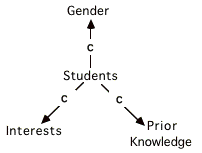
This type of structure is common when the central concept is being defined; the subordinate concepts are typically important defining attributes of the central concepts.
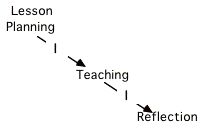
Sequences and Cycles. A sequence is a string of concepts that represent a series of events, or other concepts. A cycle is similar to a sequence except the concepts are arranged in a ring. The most common relationship appearing in sequences or cycles is "leads to." For example:
Sequence
OR
Cycle
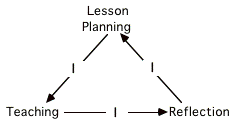
This structure might be found in a chronologically organized description of some event, a series of causally related concepts or perhaps a step-by-step description of a procedure.
Hierarchies. A hierarchy is a structure that is used to express the relationship among nested sets of categorical concepts. The relationships most commonly appearing in hierarchies are "part of" and "type of." For example:
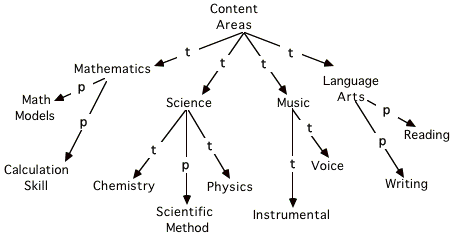
These structures are found in descriptions of large organized bodies of knowledge. This type of structure often appears as an introduction or summary of a chapter or article.
Analogies. Analogies are situations where some of the attributes of concepts are related to the concept in ways that are similar to the attributions of another concept. This structure will look like two (or more) clusters with characteristics of each cluster related with the symbol for ≥analogous to.≤
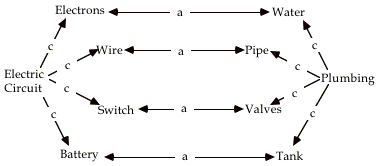
It should be noted that the similarity only exists within the systems defined by the main concepts. In this example, water is not analogous to electricity, except as each are related to the concepts plumbing and electric circuit respectively.