The mission of The Center for Excellence in Education at
Northern Arizona University is to prepare education professionals to create the
schools of tomorrow.
NORTHERN ARIZONA
UNIVERSITY
Center for
Excellence in Education
EPS 610 Child
Psychology
Summer Session I
2003
General
Information
|
Instructor: |
Dr. John R. McClure |
Phone: |
523-0578 |
|
Office: |
154 Eastburn Bldg. |
e-mail: |
john.mcclure@nau.edu |
|
Credit Hours: |
3 hr. |
Office Hours: |
Tuesday and Wednesday 8:00-9:00 a.m. and by appointment. |
Prerequisite
EPS 580 (Human Development) is a prerequisite for this course. If you have not completed EPS 580, you should see me as soon as possible.
Course Description
This course is a graduate level course emphasizing contemporary views of child psychology from a developmental perspective. The course provides students with an overview of developmental theories as they apply to understanding children. Through the study of developmental theories and discussions of social and educational issues relevant to childhood, students will gain a better understanding of how family, community and school environments affect childrenπs learning and the development of their intellectual abilities and personality.
Course Objectives
At the conclusion of this course, students will:
1. Understand the common issues addressed by developmental theories.
2. Understand the arguments for and against "nature" and "nurture" as factors that may affect the physical, psycho-social and cognitive development of children.
3. Compare and contrast theories of the physical, psycho-social and cognitive development of children.
4. Apply theories of physical, psycho-social and cognitive development to the analysis of psychological issues of infancy, early middle and late childhood.
5. Understand the basic techniques and issues of research in child development.
Course Structure
Class sessions will typically follow a lecture discussion format; however, where appropriate, we will utilize other instructional formats, such as cases studies, small group discussions, films, etc.
Readings and
Required Text
Required Texts: Thomas, R.M. (1996). Comparing Theories of Child Development, 5th Edition. Brooks/Cole Publishing Company, Pacific Grove, CA.
Additional required and optional readings are on electronic reserve at the Cline Library. The optional readings are made available to allow students to enrich their understanding of certain topics, or in some cases, review basic ideas that are essential to understanding the required readings.
Course Requirements
Class attendance and participation are required. If you are absent for any reason, I expect that you will communicate that reason to me in a timely fashion. When possible you should notify me in advance of any absence. You are responsible for the material covered on any missed days as the result of an absence. Scheduled examinations, missed for appropriate reasons will be made up without penalty. Participation is defined as appropriate and consistent contribution to classroom activities. I reserve the right to consider your attendance and participation patterns when assigning final grades.
Readings: The assigned readings are to be completed prior to the class period for which they are assigned. Effective participation in class discussions and other activities require familiarity with the concepts and issues presented in the readings. Optional readings are provided for enrichment, or to bring students up to date on basic concepts essential to the understanding of required readings.
Examinations. There will be three examinations (the two midterms and a final examination). The format for the exams will be a combination of definitions and short answer and multiple-choice items. Each examination will be worth 100 points.
Take home Essays. There will be three sets of take-home essays that will be due the day before each examination. These essays will be your responses to three probes. The response to each probe should be typed double spaced on separate pages and no more than one page in length. Your response to each probe will be worth 10 points and the set of take-home essays will be worth 30 points.
|
Assignment |
Point
Value |
Date
Due |
|
Take-home essays #1 |
30 points |
6/11 |
|
Midterm Examination 1 |
100 points |
6/12 |
|
Take-home essays #2 |
30 points |
6/23 |
|
Midterm Examination 2 |
100 points |
6/24 |
|
Take-home essays #3 |
30 points |
7/1 |
|
Final Examination |
100 points |
7/2 |
|
Total |
390 points |
|
Evaluation Methods
Grading: Grades will be awarded based on the weighted average of grades for the assignments described above. The final grades will be as follows: A = 90% to 100%, B = 80% to 89%, C = 65% to 79%, D = 55% to 64% and F < 55%.
Course Policies
1. If you are unable to take an examination at the regularly scheduled time, the instructor must be contacted in advance.
2. All written assignments must be typed or word processed, double spaced with margins of approximately 1 inch. Grades for written assignments will consider: (a) mechanical characteristics (spelling, grammar, APA style etc.), (b) the organization and coherence of ideas and arguments and (c) the accuracy of content and assertions. No papers will be accepted that are not in the proper format.
3. All assignments must be submitted on the due date to receive full credit.
4. Plagiarism is when a person willfully and knowingly uses the work of others and attempts to present it as his/her own. Academic dishonesty includes plagiarism, cheating on tests, or lying about work involved in class. The policies in the NAU Student Handbook apply to such situations.
Topics Readings and
Tentative Due Dates
The list of topics, scheduled below, is tentative. The instructor reserves the right to modify the schedule based on contingencies that may arise as the semester progresses.
Date |
Topics/Readings and Objectives |
6/3 |
Course IntroductionReadingsNoneObjectives/Study QuestionsÄ Describe the intention and organization of this course. |
Unit 1: Theories and Research of Child Development |
|
6/4 |
The Nature of Theories of DevelopmentReadingsThomas, Chapter 1Objectives/Study QuestionsÄ Define the following terms: theory, model, paradigm, principles, and laws.Ä What is the relationship between facts and theories suggested by the author?Ä List and discuss the 14 standards the author uses to compare theories of development. |
6/5 |
The Nature and Value of Theories of DevelopmentReadingsThomas, Chapter 2Objectives/Study QuestionsÄ List and discuss the content characteristics of theories of development. |
6/6 |
The Value of the Science and Theories of PsychologyReadingsThomas, Perspective ≥C,≤ and ≥E≤Bukatko & Daehler (1995). Child Development: a Thematic Approach (2nd Ed.) Chapter 1Objectives/Study QuestionsÄ Define the following terms from the readings: control, reality, precision, reproducibility, significance, feasibility, and functional relationship.Ä List and discuss the common ways in which evidence is gathered?Ä List and discuss the common research designs?Ä List and discuss the strengths and weaknesses of various research methodologies applied to the study of development.Ä Discuss the chronological location of cause proposed by various theories of development. |
Date |
Topics/Readings and Objectives |
Unit 2: Phsycoanalytic Views of Development |
|
6/9 |
Psychoanalytic Approaches to Development: FreudReadingsThomas, Chapter 5Objectives/Study QuestionsÄ Define the following terms from Freudπs theory: levels of consciousness, id, ego, superego, libido, pleasure principle, primary process, reality principle, secondary process, ego ideal, conscience, defense mechanism, cathexis, fixation, regression, erogenous zone, and ego strength.Ä Describe Freudπs view of development in childhood.Ä Discuss the strengths and weaknesses of Freudπs Theory using the 14 standards listed in chapter 1 of the text. |
6/10 |
Psychoanalytic Approaches to development: Eriksonπs and Other Extensions of Freudπs Theory.ReadingsThomas, Chapters 6Objectives/Study QuestionsÄ Define the following terms from Eriksonπs theory: ego identity, psychosocial crisis, radius of significant relations, psychosocial modality, virtue, and epigenetic principle.Ä Compare and contrast Eriksonπs view of development with Freudπs.Ä Describe Eriksonπs stages of development as they apply to childhood.Ä Discuss the strengths and weaknesses of Eriksonπs Theory using the 14 standards listed in Chapter 1 of the text. |
6/11
|
Review (Take home essays #1 due) 1. Read pespective ≥A≤
and discuss how psychoanalytic theories address the four aspects of normality
presented in this reading. 2. Discuss the causes of childhood problems from the perspective of psychoanalytic theory. 3. What advice would Erikson give to parents of children who are in the first 4 stages of development? |
Date |
Topics/Readings and Objectives |
6/12 |
Examination
1
|
Unit 3: Learning Perspectives on Development in Childhood |
|
6/13 |
Behavioral Learning Theories and Child DevelopmentReadingsThomas, Chapter 7Objectives/Study QuestionsÄ Define the following terms from behavioral learning theory: classical conditioning, operant conditioning, reinforcement, positive reinforcer, negative reinforcer, punishment, extinction, generalization, discrimination, reinforcement schedule, shaping, chaining.Ä Discuss behavioral perspectives on child development.Ä Discuss the role of nature in operant views of child development?Ä Discuss the strengths and weaknesses of behavioral theories of development using the 14 standards listed in Chapter 1 of the text |
6/16 |
Social Learning and Child DevelopmentReadingsThomas, Chapter 8ObjectivesÄ Define the following terms from social-cognitive learning theory: contextualism, modeling, incidental learning, self-efficacy,Ä Describe the process of learning from models.Ä Discuss the social-cognitive view of mental illness and the treatment of mental illness.Ä Discuss the strengths and weaknesses of social-cognitive theories of development using the 14 standards listed in Chapter 1 of the text. |
Unit 4: The Development of Mental Ability |
|
6/17 |
Piagetπs Theory of Cognitive Development.ReadingsThomas, Chapter 9Objectives/Study QuestionsÄ Define the following terms from Piagetπs theory: genetic epistomology, scheme, functinoal invariants, assimilation, accommodation, equalibrium, circular reactions, object relations. Operations, egocentric speech, social communication, centration, conservation, .decalage,Ä Discuss Piagetπs view of the role of nature and nurture in the development of mental ablity.Ä Discuss the strengths and weaknesses of Piagetπs theory of intellectual development using the 14 standards listed in Chapter 1 of the tex |
6/18 |
Neo-Piagetian Extensions on Piaget.ReadingsCase (1995). Neo-Piagetian theories of child development. (in Robert Sternberg and Cynthia Berg, Eds.) Intellectual DevelopmentObjectives/Study QuestionsÄ Define the folllowing terms from neo-Piagetian theory:Ä Discuss the criticisms of Piagetπs theory of cognitive development as presented by Case.Ä Describe Caseπs theory of cognitive development in using the 13 content characteristics from Chapter 2 of the text. |
6/19 |
Vygotskyπs Theory of Cognitive DevelopmentReadingsThomas, Chapter 10Vygotsky, Lev . (1978). Play and its role in the mental development of the child. in Judith Krieger Gardner (Ed.). Readings in Developmental Psychology, Little, Brown and Company, Boston.Objectives/Study QuestionsÄ Describe Vygotskyπs view of development in childhood using the 13 content characteristics from Chapter 2 of the text.Ä In what ways were Vygotskyπs theories influenced by Marxist ideology?Ä Describe and critique Vygotskyπs research methodology.Ä According to Vygotskyπs theory, what is the relationship between thought and language?Ä How is memory viewed in Vygotskyπs theory?Ä Discuss the strengths and weaknesses of Vygotskyπs theory of development using the 14 standards listed in Chapter 1 of the text. |
6/20 |
Information Processing Views of DevelopmentReadingsThomas Chapter 11Kail and Bisanz (1995). The
information processing perspective on cognitive development in children. (in Robert Sternberg and Cynthia Berg,
Eds.) Intellectual
Development
Objectives/Study QuestionsÄ Describe information processing view of cognitive development in using the 13 content characteristics from Chapter 2 of the text.Ä Compare and contrast information processing theory to the theories of the neo-Piagetians.Ä Discuss the strengths and weaknesses of information processing theories of development using the 14 standards listed in Chapter 1 of the text. |
Date |
Topics/Readings and Objectives |
6/23 |
Review (Take home essays #2 due) 1. Compare
and contrast the theories of Vygotsky and Piaget with regard to their
implications for education. 2. 3. |
6/24 |
Examination 2
|
Unit 5: Bilogical Views of Development |
|
6/25 |
Ethological Views of Child DevelopmentReadingsThomas, Chapter 14Thomas, Chess and Birch. The origin of personality, 3.2 in (Rhett Diessner, Ed.)Sources.Objectives/Study QuestionsÄ Describe ethological view of development in childhood using the 13 content characteristics from Chapter 2 of the text.Ä What are the evolutionary relevant advantages of attachment?Ä Discuss the strengths and weaknesses of ethological theories of development using the 14 standards listed in Chapter 1 of the text. |
Date |
Topics/Readings and Objectives |
6/26 |
Psychometric Views of Cognitive DevelopmentReadingsThomas, Chapter 15Gardner and Clark (1995). The psychometric perspective on intellectual
development in childhood and adolescence. in (Robert Sternberg and Cynthia Berg Ed.) Intellectual
development
Anastasi. Heredity, environment and the question of how, 3.2 in (Rhett Diessner, Ed.)Sources.Objectives/Study QuestionsÄ What is the psychometric view of intelligence?Ä Describe psychometric view of intellectual development in using the 13 content characteristics from Chapter 2 of the text.Ä Discuss the strengths and weaknesses of the psychometric view of intellectual development using the 14 standards listed in Chapter 1 of the text. |
Date |
Topics/Readings and Objectives |
Unit 6: Moral development |
|
6/27 |
Theory of Moral DevelopmentReadingsThomas, Chapter 16Objectives/Study QuestionsÄ Describe Kohlbergπs theory of moral development in using the 13 content characteristics from chapter 2 of the text.Ä Describe the relationship between Piagetπs theory of cognitive development and Kohlbergπs theory of moral developmentÄ Discuss the strengths and weaknesses of Kohlbergπs theory of moral development using the 14 standards listed in chapter 1 of the text. |
6/30 |
Integrated View of Moral DevelopmentReadingsThomas, Chapter 17Objectives/Study QuestionsÄ Discuss the major criticisms of Kohlberg and Piagetπs view of moral development.Ä Discuss the relationship between the integrated theory of moral development presented in Chapter 17 of the text and other theories of development.Ä Describe the integrated theory of moral development presented in Chapter 17 using the 13 content characteristics from Chapter 2 of the text.Ä Discuss the strengths and weaknesses of the integrated theory of moral development presented in Chapter 17 using the 14 standards listed in Chapter 1 of the text. |
7/1 |
Review (Take home essays #3 due) |
7/2 |
Final Examination |
Readings on electronic reserve in the Cline Library
Bukatko, D. and Daehler, M.W. (1995). Child Development: a Thematic Approach (2nd ed.) Houghton Mifflin Co. Boston.
Case, R., (1995). Neo-Piagetian theories of child development. in (Robert Sternberg and Cynthia Berg Ed.) Intellectual development Cambridge University Press, New York
Gardner
and Clark (1995). The psychometric perspective on intellectual development in
childhood and adolescence. in
(Robert Sternberg and Cynthia Berg Ed.) Intellectual development , Cambridge University Press, New York
Kail and Bisanz (1995). The information processing perspective on cognitive development in children. in (Robert Sternberg and Cynthia Berg Ed.) Intellectual development , Cambridge University Press, New York
Rhett Diessner (Ed.). (1997). Sources: Notable Selections in Human development. Duskin/McGraw-Hill, Guilford CN
Judith Krieger Gardner (Ed.). (1978). Readings in Developmental Psychology, Little, Brown and Company, Boston.
Assessment of Essays
Each set of take-home essays will be evaluated according to the following criteria:
Mechanics: Was the assignment prepared in the proper format, with no mechanical errors (spelling, grammar, etc.), that detract from the readerπs understanding?
Organization: The sequence of ideas for each essay response is logically organized and contributed to the readerπs understanding.
Content: The essays address the assignment and indicate an adequate understanding of the concepts presented in the course readings and discussion.
CONCEPT MAPPING
Two concepts connected by an arrow are referred to as a proposition. The direction of an arrow points from a super-ordinate concept to the subordinate concept of the proposition. For example:

The labels for the arrows may be words that indicate specific relationships; but often categories of relationships may be indicated by letters.
LABELS
Below are examples of letters that are commonly used to indicate relationships on concept maps presented in this course.
Leads to = "L." This label indicates that the two connected concepts are related in a sequential way, such as cause-effect relationships, or step-wise relationships, i.e. the superordinate concept occurs before, causes or affects in some way the subordinate concept. The "L" may be read as "causes≤, "affects," leads to," etc. For example:

This should be read as, "Learning affects Knowledge."
Characteristic of ="C." This label is used when the subordinate concept is a characteristic of the superordinate concept. For example:

This can be read as, "A characteristic of teachers is personality."
Part of ="P." This label is used when the subordinate concept is a part of the superordinate concept. For example:

This can be read as, "A part of a lesson is an introduction."
Type of ="T." This label is used when the subordinate concept is a type of the superordinate concept. For example:

This can be read as, "Psychological is a type of science."
Example of ="E." This label is used when the subordinate concept is an example of the superordinate concept. For example:

This can be read as, "An example of a theory is Piagetπs theory."
Analogous to ="A." This label is used when the concepts are similar on some level. Not the arrow points in both directions, there is not superordinate/subordinate relationship. For example:

This can be read as, "the human mind is analogous to a computer," or as ≥problem solving is similar to learning.≤
ORGANIZATION OF
CONCEPTS
One of the advantages of creating a concept map is that the organization or structure among the concepts is made explicit. There are four types of structures that are commonly found in concept maps: (a) clusters, (b) sequences, (b) cycles and (d) hierarchies.
Clusters. A cluster is a central superordinate concept surrounded by a number of subordinate concepts. The relationship among the concepts in a cluster is frequently "characteristic of." For example:
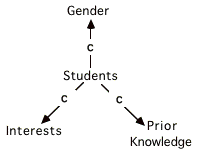
This type of structure is common when the central concept is being defined; the subordinate concepts are typically important defining attributes of the central concepts.
Sequences and Cycles. A sequence is a string of concepts that represent a series of events, or other concepts. A cycle is similar to a sequence except the concepts are arranged in a ring. The most common relationship appearing in sequences or cycles is "leads to." For example:
Sequence
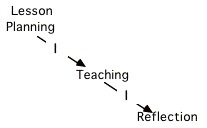
OR
Cycle
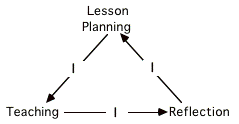
This structure might be found in a chronologically organized description of some event, a series of causally related concepts or perhaps a step-by-step description of a procedure.
Hierarchies. A hierarchy is a structure that is used to express the relationship among nested sets of categorical concepts. The relationships most commonly appearing in hierarchies are "part of" and "type of." For example:
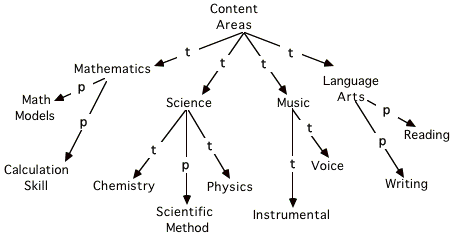
These structures are found in descriptions of large organized bodies of knowledge. This type of structure often appears as an introduction or summary of a chapter or article.
Analogies. Analogies are situations where some of the attributes of concepts are related to the concept in ways that are similar to the attributions of another concept. This structure will look like two (or more) clusters with characteristics of each cluster related with the symbol for ≥analogous to.≤
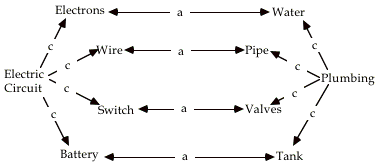
It should be noted that the similarity only exists within the systems defined by the main concepts. In this example, water is not analogous to electricity, except as each are related to the concepts plumbing and electric circuit respectively.