
Maize Roundtable Summary
Notes from Round Table Vias del Noroeste May 22 2006
(notes by Jane Hill, augmented with info from tape before it ran out)
Panel Participants: Karl Taube, Danny Lopez, Stewart Koyiyumptewa, Theodora Homewytewa; Kelley Hays-Gilpin moderating.
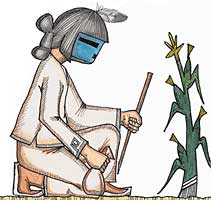
Karl Taube sketched the symbol with the corn-field as a four-quartered world with corn ears.
Theodora Homewytewa (Hopi) will “give the ‘ladies version’ of Hopi corn.”
T. Homewytewa: 1) White corn is the "mother corn" given to a newborn. 2) It's used to make hominy and 3) a special pudding (piqami) served with hominy during ceremonies 4) White corn is used in ceremonies. At marriage, you get blue corn and white corn. Blue corn shows up in somiviki and piki bread. It's not just for food, but for the marriage, or to pay for dancing partners (it's very expensive to buy).
Remarks on piki stones.
Yellow corn is used for puddings and in piki for special weddings, for Bean Dance -- White piki. Wedding "paybacks" to the husband's family. Everyone gets some so you need big garbage cans full of corn meal. "Our poor husbands work really hard planting and then we go give it to somebody else." You always carry your corn when you move, "Corn is life". You have to have it for rituals, for your kids’ lives. "If I didn't have any corn anywhere stored up I would be the poorest woman on the reservation." Eating is from the earth, medicine is from the earth. If you get sweet corn from the store, it's sweet and it doesn't last. Hopi corn lasts -- you store it even 10 years. Each year's harvest goes into storage. Hominy uses old corn. The hulls break up better after three years and will just pop nicely. S. Koyiyumptewa (from Hotevilla village on Third Mesa, and works for the Hopi Cultural Preservation Office). His grandfather and uncles made him get up really early and he hated it but now he understands about that because you have to get up really early to be a farmer. He had his Hopi wedding in 2000. The man has to provide corn to his wife and daughter so they can give it to other people, so he started planting after his wedding. He would spend nights in the fields to protect his corn. It turns out getting up really early is the best time to work, before the sun comes up is a really nice time. They do dry farming so you have to pray for rain. You have to really watch the corn, thin it, take care of it.
[Tape starts here—KHG adding notes to J. Hill’s]
Karl Taube. Mentions corn symbolism, similarity of this in Mesoamerica and Southwest, San Bartolo murals. Guatemala.
D. Lopez, “I’m not the expert and I don’t know how I got on this panel. Seems like you are supposed to talk about something way back, and although I’m an elder….!” (implying he doesn’t go that far back). He saw the last part of the time when the TO planted. Stopping planting was "the biggest mistake we made." The men would get together and take the plows to the east side of the village. At that time we had horses and plows. Started at the east side, fields all connected, and move toward the west. At his home village (Big Fields, I think) they had about 20 fields. The plowing direction was because the first rain would be further east. Back then, 50 years ago, we depended on the rain water. Back then, the rain ceremony was so important. Pray for rain, sing for rain. There were prayers for rain, when it fell it was scattered. Each day might rain in a different place. “That’s what I remember, the community working together.” It would take three or four days to finish the fields. “You have to take care of it.” Constantly. You have to be out there watching the corn, singing to it, talking to it. Pray, to encourage it. Come harvest time, they'd invite other families to help harvest and pay in corn, “Take what you need”, "It was a community working together." "Now we just argue Politics, religion, technology changed our way of life. Cotton farmers recruit workers. –“today what were our fields are full of mesquite." TO Community Action uses pump water, but the weather has changed, the rain doesn't come on time the way it used to. The weather system has changed, the rains don’t come on time. They are trying to teach young people to do the rain ceremonies. It’s not just the ceremony, a lot of things tie into that ceremony. Corn mentioned in legends, it was one of the people. Corn is a person in native culture. The corn was small, but that’s what we survived on. The old corn was 60-day corn, very tolerant of heat. The crops were huuñ, ha:l, c muuñ (corn, squash, and beans), and not talking about the pinto bean, but the tepary bean, that was the original bean we had. Those were our crops, the original crops, what we got off the land, spinach, saguaro fruit, the prickly pear fruit. When it was time to grind corn, men didn't handle the maccud (metate), but Danny could use a hand grinder to make crushed corn (TO word -- kai'isa?? need to look up. My mother would say get over here and grind, and I hated that, so much work, for me). Then we also made [ka’iktsa?] parched corn. They're trying to encourage folks to avoid diabetes by eating those foods—tepary bean, cholla buds. But it’s hard to make people change their ways. I envy the Hopi because they seem to have more of their culture. And it’s your culture that helps you carry on your life, your health, your ceremonies.
There's a story I’d like to share-- Some men stole dynamite from a mine in the mountains and took it back to their village and buried it in the corn field and didn't tell anybody. The dynamite was used to blast out springs to get water in the mountain village. Anyway, come planting season, the corn came up, and it was harvest time and the ladies were going to roast the corn in the field. They didn’t know there was a box of dynamite down there. They built the fire close to or right over the buried dynamite and the box exploded and it was really funny to see all the old ladies standing there all black with soot. Fortunately nobody died. Later on some of the men said they thought maybe some bad medicine man did something, but then they admitted they buried the dynamite there. There are songs that mention corn, squash. Back then, we were healthy people. It’s our fault we changed. They were healthy and worked hard. We never heard of diabetes till about 60 years ago, when things began to change. I do know corn songs; we sing them in our social songs, our rain ceremony, also squash. “That’s all I know.”
T. Homewytewa: When things go wrong we blame the Anglo people, we say the White People. From the conquistadors on down the paha:na take up new stuff and say it's gonna make it good and then things go wrong. "Don't blame the Indians, we're just back here watching you." Computers are making everybody lazy; people don't do any manual labor. With telephones it's the same thing. It used to be that if you wanted to visit with your relatives you had to walk over there, now you can just call. People don't walk around any more. “Our legend says that this is gonna happen in the future, you just sit back and watch.” Our legends tell us how to eat from the earth, harvest spinach, etc. And some people are gifted for leadership or whatever. “This is why we are surviving.” Expresses concern about waves coming through the body [electromagnetic radiation]. “Technology is here, but it’s not good. I’m getting into…..” [getting side-tracked]
Kelley Hays-Gilpin: Corn doesn’t take care of itself, it doesn’t walk; people brought it here, with a purpose, a reason. They took care of it by working hard. Corn takes care of us when we take care of it. Danny said corn is a person, and we are seeing that in the pueblos as well. How far back does this go? Especially the idea of corn as a person?
Karl Taube: I think it goes back to the formative Olmec. We see the corn god as early as 900BC. In the Olmec area there are sacred mountains. They were making offerings of jade celts at 1500BC. Also, the corn is the world, four worlds, four directions. He drew a San Lorenzo pottery vessel from 1000BC. It shows a world center (cross) with four ears of corn around it. This is a very ancient pattern. Corn is your body, your life, the world. The Tzotzil Maya cut the umbilical cord on corn.
KHG: asks if there are any stories about corn about how people and corn came to be.
D. Lopez, "Nobody will tell stories now [in the summer], they're for the winter."
T. Homewytewa: If you tell stories now snakes will bite you. We live with a lot of restrictions. It’s to teach you. Things like this. It’s a lesson itself. The importance of corn would be best described in the directional effort of it. I’m going to pick on Ferrell, my nephew, he would know. There’s different colors that go here and there. We have a story that the different tribes came together and they picked different corn. He’s very traditionally raised and he knows a lot about our cultural knowledge.
Ferrell Secakuku: Some of the stories and symbolism that we talk about is very sensitive. So I’ll tell a story in the way it would make sense to you. What happens in the emergence. Corn comes from the Third World to this level. And we could expand into migration. The different colors of corn were laid out on the ground. When we first emerged here we found a supreme power and today recognize him as the owner of the whole world, not just this piece here. Maasaw owned the world. He was our spiritual father and we asked him to be our leader. He refused to be a leader. He gave certain instructions to live by, rules, to take care of the earth. There was lots of discussion at the emergence. Everybody spoke one language, everybody was the same, no ethnic groups, no nationalities, no tribes. We disagreed on many things. He saw what would be the best way for us to live and to take care of this earth. So Maasaw laid out the colors and sizes of corn and asked each group to chose. We were still one people but perhaps were divided into families. There were several tribes, Navajo, Apache, maybe Tohono O’odham. You can see that in the kiva. That’s how we cover up some of these things that are religiously important, we do it in the kiva. He asked the leader of each group to pick a kind of corn. Some rushed to get the best kind. What they figured would be the best thing for them in the future. A Mocking Bird was helping Maasaw and gave them languages as they picked their corn and stepped aside, and sent each group in different directions to speak their own language. That’s what gave them their ethnicity, nationality. He asked every one of them to go different directions, and make their life as people. That’s the determination of who you are going to be. And we still practice that. We designate yellow as a northern color, yellow corn.
Yellow-north, Blue--west, Red -- south, White -- east, Above -- dark corn, where spiritual forces are, we try to harness these and bring rain; below-Hopi sweet corn, "kinda greyish, all corn mixed together under the world and gives strength" Special one, sweet because it combines every kind of food. The directions, our cardinal directions, touches us. That’s what gives us spiritual strength. And the bottom, that’s where we came up from, that gives us strength, too. We harness all the spiritual forces so it will rain.
We show newborn to the sun, our spiritual father, represents the top. Everything we do today began at the Emergence. Corn. We are now doing our corn planting, how to take care of it, how to do the prayers, all that is done the way we were shown at the beginning. "We're the most praying people of the universe". We have one of the most difficult lives. He just finished a ceremony yesterday. Have to sacrifice. They stay up all night four days, then have the dance, then on the fourth day smoking. A story: The agent at Keams Canyon in the 1930s reported "These Indians are always preparing or recuperating from a ceremony". “I have not seen any change for the last 30-40 days I have been here.” That’s still true. But we have some of the influences from the outside. Technology, education, impact on children. 48% of kids don't speak Hopi and understand Hopi. But that’s the basis for our culture and our religion. But you have to do that to keep up what we're supposed to do. How can we carry out what we accepted to do at the beginning of time? We live in the same place a long time, a thousand years, and we’ll still be there another 1000 years. But without our language we can’t carry about the commitment we made to Maasaw. Ceremonies and religion for commitment to Maasaw. "We are in a crisis situation. There are a lot of teachings, called navoti, that we have to teach them but how can you teach young people if they don't understand the language?
[tape runs out here]
The elders have to interpret in the kiva for those who don’t speak Hopi. He refuses to do this.
[end of discussion]
