 |
|||||
 |  |  |  |  |  |
 |
 |  |
|||
| ESE504 : The Class : Essentials : Development | |||||
 >
>
Development of Will
by J'Anne
Ellsworth

The interplay of autonomy and heteronomy are so ubiquitous in human nature, that a great deal of energy and deep emotion surround social and community issues of power, control and responsibility. We sometimes take the social surroundings for granted. As a solitary being, the child is not competitive, has no jealousy, no context for competitiveness. There is no one to lie to, no one to cheat. To be alone is to be powerful. To be alone is to be lonely.
The youngster is drawn to have power, to construct life as a soliloquy, yet is not satisfied. The youth’s ideal fantasy suggests community that provides companionship, yet community that consists of a powerless entity who exists to serve, who thinks of nothing but meeting the child’s needs. Even if we were to accomplish that momentary end, there would be great dissatisfaction in it. To have the abject devotion of another is little different than having a sniveling cur for a companion. Thus our early dreams of total subjugation of others in our own service are immature and impossible whimsy.
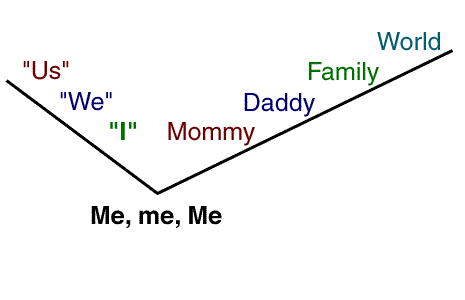
Some people spend a lifetime learning that community is a give and take. Some never seem to move from egocentric self involvement to find the joy and satisfaction in pleasing self in the service of others. Power and control are keys in understanding this function of ourselves, our students and the dynamics of the family, the classroom the child in social context. The importance of these keys to human behavior emerged in early literature in the writings of Aristotle, Homer, Shakespeare, Bacon. It is woven through the writing and theories of many philosophers. It is noted in texts about human development by numerous writers, notably, Piaget (1965), May (1966), Fromm, (1973), Glasser (1984), and is measured in personality tests using terms like ascendance - submission, internal locus of control, leadership, empowerment. It is a recurring theme in psychology, and a primary component of understanding development of the self (Jung,1933; Erikson,1980).
Power and control are an integral part of social interactions, relationships, and community interchanges (Montuori & Conti, 1993). They may be external cues of personality traits that are embedded in interactions. If so, we can recognize, study and understand this part of a child or person in social context and relationship. The awareness that power and personality are intertwined may explain the ease or difficulty a student has in becoming part of the learning community or a child fights blending into a group of siblings and also explain why some youngsters seem difficult to manage.

Seeing power as both social and personal (Elias & Clabby, 1992) also allows teachers and parents to view youthful persistence in maintaining a set of responses and behaviors as more than stubbornness and different from dysfunction. It could assist those in authority to see a systemic base for repercussions that are the common result of efforts to step in and wrest authority through a power struggle. It may provide new ways of viewing teacher responses to power struggles and open untried and better ways of dealing with child behavior that is currently viewed as fractious and willful. Looking at internal need for control - for autonomy, can also also give us some perspective on why students "misbehave" and what some of the payoffs may be. Frequently the changing human element leads us to misinterpret who is in control and who has been listed as being in charge or claims to be in charge. The following story provides an illustration of these points.
A Game of Catch
Richard Wilbur
Monk and Glennie were playing catch on the side lawn of the firehouse when Scho caught sight of them. They were good at it, for seventh graders, as anyone could see right away. Monk, wearing a catcher's mitt, would lean easily sideways and back, with one leg lifted and his throwing hand almost down in the grass, and then lob the white ball straight up into the sunlight. Glennie would shield his eyes with his left hand and, just as the ball fell past him, snag it with a little dart of his glove. Then he would burn the ball straight toward Monk, and it would spank into the round mitt and sit, like a still-life apple on a plate, until Monk flipped it over into his right hand and, with a negligent flick of his hanging arm, gave Glennie a fast grounder.
They were going on and on like that, in a kind of slow mannered, luxurious
dance in the sun, their faces perfectly blank and entranced, when Glennie
noticed Scho dawdling along the other side of the street and called hello
to him. Scho crossed over and stood at the front edge of the lawn, near
an apple tree, watching.
"Got your glove?" asked Glennie after a time. Scho obviously
hadn't.
"You could give me some easy grounders," said Scho. "But don't burn 'em."
"All right," Glennie said. He moved off a little, so the three of them formed a triangle, and they passed the ball around for about five minutes, Monk tossing easy grounders to Scho, Scho throwing to Glennie and Glennie burning them back to Monk once or twice before he let Scho have his grounder, and finally Monk gave Scho a fast, bumpy grounder that hopped over his shoulder and went into the brake on the other side of the street.
"Not so hard," called Scho as he ran across to get it.
"You should've had it," Monk shouted.
It took Scho a little while to find the ball among the ferns and dead leaves, and when he saw it, he grabbed it up and threw it toward Glennie. It struck the trunk of the apple tree, bounced back at an angle, and rolled steadily and stupidly onto the cement apron in front of the firehouse, where one of the trucks was parked. Scho ran hard and stopped it just before it rolled under the truck, and this time he carried it back to his former position on the lawn and threw it carefully to Glennie.
"I got an idea," said Glennie. "Why don't Monk and I catch for five minutes more, and then you can borrow one of our gloves?"
“That's all right with me," said Monk. He socked his fist into his mitt, and Glennie burned one in.
"All right," Scho said, and went over and sat under the tree. There in the shade he watched them resume their skillful play. They threw lazily fast or lazily slow - high, low, wide - and always handsomely, their expressions serene, changeless, and forgetful. When Monk missed a low backhand catch, he walked indolently after the ball, and, hardly even looking, flung it sidearm for an imaginary put-out. After a good while of this Scho said, "Isn't it five minutes yet?"
"One minute to go," said Monk, with a fraction of a grin.
Scho stood up and watched the ball slap back and forth for several minutes more, and then he turned and pulled himself up into the crotch of the tree.
"Where are you going?" Monk asked.
"Just up the tree," Scho said.
"I guess he doesn't want to catch," said Monk.
Scho went up and up through the fat light-gray branches until they grew slender and bright and gave under him. He found a place where several supple branches were knit to make a dangerous chair, and sat there with his head coming out of the leaves into the sunlight. He could see the two other boys down below, the ball going back and forth between them as if they were bowling on the grass, and Glennie's crewcut head looking like a sea urchin.
"I found a wonderful seat up here," Scho said loudly, "If I don't fall out."
Monk and Glennie didn't look up or comment and so he began jouncing gently in his chair of branches and singing "Yo-ho, heave ho", in an exaggerated way.
"Do you know what, Monk?" he announced in a few moments. "I can make you two guys do anything I want. Catch that ball, Monk! Now you catch it Glennie!"
"I was going to catch it anyway," Monk suddenly said.
"I made you say what you just said," Scho replied joyfully.
"No, you didn't," said Monk, still throwing and catching but now less serenely absorbed in the game.
"That's what I wanted you to say," Scho said.
The ball bounded off the rim of Monk's mitt and plowed into a gladiolus bed beside the firehouse, and Monk ran to get it while Scho jounced in his treetop and sang, "I wanted you to miss that. Anything you do is what I wanted you to."
"Let's quit for a minute," Glennie suggested.
"We might as well, until the peanut gallery shuts up," Monk said.
They went over and sat cross-legged in the shade of the tree. Scho looked down between his legs and saw them on the dim, spotty ground, saying nothing to one another. Glennie soon began
abstractedly spinning his glove between his palms; Monk pulled his nose and stared out across the lawn.
"I want you to mess around with your nose, Monk." said Scho, giggling. Monk withdrew his hand from his face.
"Do that with your glove, Glennie," Scho persisted. "Monk, I want you to pull up hunks of grass and chew on it."
Glennie looked up and saw a self-delighted, intense face staring down at him through the leaves. "Stop being a dope and come down and we'll catch a few minutes," he said.
Scho hesitated, and then said, in a tentatively mocking voice, "That's what I wanted you to say."
"All right, then, nuts to you." said Glennie.
"Why don't you keep quiet and stop bothering people?" Monk asked.
"I made you say that," Scho replied, softly.
"Shut up," Monk said.
"I made you say that, and I want you to be standing there looking sore. And I want you to climb up the tree. I'm making you do it!"
Monk was scrambling up through the branches, awkward in his haste, and getting snagged on twigs. His face was furious and foolish and he kept telling Scho to shut up, shut up, shut up, while the other's exuberant and panicky voice poured down upon his head.
"Now you shut up or you'll be sorry," Monk said, breathing hard as he reached up and threatened to shake the cradle of slight branches in which Scho was sitting.
" I want ----" Scho screamed as he fell. Two lower branches broke his rustling, crackling fall, but he landed on his back with a deep thud and lay still, with a strangled look on his face and his eyes clenched. Glennie knelt down and asked breathlessly, "Are you O.K., Scho? Are you O.K.?" while Monk swung down through the leaves crying that honestly he hadn't even touched him, the crazy guy just let go. Scho doubled up and turned over on his right side, and now both boys knelt beside him, pawing at his shoulder and begging to know how he was.
Then Scho rolled away from them and sat partly up, still struggling to get his wind but forcing a species of smile into his face.
"I'm sorry, Scho." Monk said. "I didn't mean to make you fall."
Scho's voice came out weak and gravelly, in gasps. "I meant -- you to do it. You --- had to. You can't do --- anything --- unless I want --- you to."
Glennie and Monk looked helplessly at him as he sat there, breathing a bit more easily and smiling fixedly, with tears in his eyes. Then they picked up their gloves and the ball, walked over to the street, and went slowly away down the sidewalk, Monk punching his fist into the mitt, Glennie juggling the ball between glove and hand.
From under the apple tree, Scho, still bent over a little for lack of breath, croaked after them in triumph and misery, "I want you to do whatever you're going to do for the whole rest of your life!"

The interplay of power, control, authority is confusing and misleading and is a favorite literary theme. This story underscores the dynamics of a youngster who comes into a situation and asserts a sense of autonomous control over others. It is difficult, in the midst of the child's antics, to extricate self and reassert a more socialized or heteronomous perspective. It is vital to recognize the interchange, however, for "Scho" shows up in every classroom, in every social gathering, both in youth and adulthood.. It is a time honored position or "hat" and it is a very appealing and self satisfying role for the child. In fact, it can become a way of life that moves into adulthood as a rather disquieting personality trait and management style. It is not an uncommon stance for adults in authority who find themselves in the midst of a power struggle - pulled in through self assertion.
The satisfaction comes in winning in a different way than the heteronomous players recognize. It is not in the playing of the game, but in the control of the players that such a child derives satisfaction. Scho could not play with the expertise of the other boys. He could not force them to want him to play, but he could make the other boys pay, could break up the game, ruin the "good time was had by all" feeling. This type of scenario happens often, setting up a feeling of despair for adults and anger from other children who feel that the grown-up should be able to control such a child. As long as compliance is a desired end result for someone in the position of authority, Scho will continue to reign. When we recognize a far greater role for children, a role of taking personal responsibility for behavior, good or bad, then Scho loses the advantage, for others cannot be easily manipulated by his unwillingness to play by the rules.
The solutions for working with autonomous children are complex. The purpose of the illustration is to establish an ability to recognize the social leader role, the child with least to lose as a person who chooses to use time and energy to exert control over others. It is to validate the recognition that temper tantrums, refusals to participate, power struggles and tears are powerful ploys and to further recognize how often that interplay in the past may have gone unrecognized as a function of control, thus perpetuating the child's ability to seem "one up" and place others in a position of feeling foolish or helpless.

Environment or child
Acknowledging power and control as functions of individually discrete
manifestations of personality as well as part of a social context, contributes
to understanding the dynamics of child and student management (Johnson
& Johnson, 1994). One focus in the literature refers to the classroom
as an environment to change and children as all made of the same fabric,
all trainable and manageable by external forces (Skinner, 1987; Canter
& Canter,1976). The tacit corollary suggests that understanding human
nature and studying or attending to individual differences is unimportant
in classroom management. In fact, the name classroom management itself
defines the role for discipline - managing “things” and environments.
The emphasis is at least an unconscious choice, for parenting is not called
home management.
Our beliefs about the purpose of the classroom and our own maturity impact the structure we develop and try to keep in place. If we view the classroom as an environment to be managed, then students who resist rules and guidelines are seen as a threat. Behavior management techniques are initiated, then punishment, then one to one behavior contracts. If a student refuses to be managed, the next option is removal from the classroom, and sometimes from the school. A ground rule in such a classroom might read. “I am here to teach, you are here to learn” [Comply and let me teach ] (Canter, 1989).
If we view the classroom as an extension of ourselves, then student attempts to change the environment may be viewed as personal assault. Any move toward independence may be a threat to the stability we arrange, any deviation may be perceived as a mutiny. Student attempts to establish personal parameters to achieve personal learning or meet a ‘needs’ agenda, tend to be viewed as at least thoughtless, and more likely as disrespectful.

In this framework, the teacher uses personal power and charisma to “charm” students into cooperating. It is a powerful model in many ways. Students love to feel included and like the personal involvement of the teacher. The teacher feels rewarded and feels a sense of bond and community with students. The deviations from teacher choices are accepted for a while as the teacher tries to “reach” the errant student. Failing that, the teacher and student progress to veiled dislike. The student baits the teacher, the teacher responds with sarcasm. The student defies the teacher, the teacher refers the student for counseling. The enmity builds between the two major players and the emotions and unrest splash into the classroom. Again, the teacher looks for a way to remove the student from class. The ground rule in this class is “I want to be liked by you.” Sometimes there are sophisticated additions to the message, but again, if students comply they are seen as likable and if they do not, they become the enemy, are seen as hostile, or are referred to special programs.
Both of these typical scenarios from today’s classrooms focus on the idea of managing the environment. Teacher is leader, teacher is boss. Teacher, by careful planning, good lessons and good intentions provides a beneficial milieu. Healthy students learn in these environments. Students who do not learn and comply in sync with others, need to be adjusted. What may appear just as obvious is that individuality, creativity, and divergent thinking or behaving are assaults to the carefully tuned environment. Students who insist on engaging in them are likely to be viewed as willful. The further the ideas or actions are from the teacher’s carefully tuned classroom, the more cacophonous they sound and the more uncomfortable they become. Eventually, environment wins out and the youth is brought into compliance or removed.
It is a very small monster, indeed, the idea of focusing on children rather than environment, but it grows to take over rapidly. A central focus on children suggests building a relationship that features training, then educating each to become competent human beings and capable citizens who eventually become partners in community (Mischel, 1979). The environment becomes a milieu and moves to a more secondary position. We act from the presumption that children have predisposed universal tendencies and states of being and we also assume they have individual gifts, talents and tendencies that are unique and that each who shares in the community will bring change and richness, texture and complexity.

We recognize that this idea of management literally involves helping each youngster set up the optimal structure for self and, simultaneously, that each participant [adults as well as children] learn to blend self desires with needs of the learning community (Johnson & Johnson, 1994). Skills for socialization and attention to individual and personal development become mutually valuable. The teacher or parent attends to acquiring a deeper understanding of human personality and honing the ability to value idiosyncratic aspects of each child. After all, learning is not a linear task, but rather an intricate and interwoven evolution of product and process, thinking and relating, sharing ideas and reframing concepts based on new and emerging perspectives.
By viewing children as the primary focus of education, our role as teacher shifts from manager of class to enhancer of each student. As environment becomes more secondary and less a personal agenda, we can feel freed to empower students to enter into the process of shared management. That includes an expectation that the social setting we devise will call forth management of self and participation in the learning community from all learning community members. The process is similar in the home environment. The child is dependent and subject to the authority of the adults at first. Over time, the decisions and functions of the family are shared. As the child becomes more able and adept, choices and consequences become mutual and cooperative agreements.
Recognizing and valuing inherent natural skills for socialization and attention to individual and personal development become important, as well. Understanding elements and components of personality and valuing idiosyncratic aspects of each youngster adds crucial elements to teaching and learning success. This knowledge base, knowing how to understand self, looking for, recognizing and valuing each individual in the family or learning community, the strengths, the idiosyncratic personalities, the needs, the desires helps in building healthy community. This further enhances the need to understand more about power and control.
As shown in the following discussion, realizing the mechanisms of power and autonomy may be the most fundamental, foundational piece for successfully moving interactions from a focus on environment to valuing and focusing on people and building relationships. If, as it appears, the human need for power and control explains most of the interactions of life, then it is crucial to see how it manifests itself and how it develops.

The power and control phenomenon appears to be present in the earliest human behaviors. The initial bonding between child and mother takes place in the first moments and hours, almost in concert with those first breaths. The infant goes through a series of eye contact moves, nuzzling behaviors and “flirting” maneuvers that contribute to bonding in the first days. (Kagan & Moss, 1962). As nurturing from the mother takes place, the bond increases. Love, if it is defined as the mutual giving of trust and a sharing of power, is not yet present in the infant, though certainly the appearance and initial foundations are in place.
In those first infant months of total dependence, the infant “controls” the mother to get needs met. The infant cries, the mother comes. Baby squirms, the mother attends. The infant makes sounds and coos - mother applauds.
The child is helpless to fulfill needs; immobile, unable to forage, incapable of toilet care or personal hygiene. It is crucial that the parent respond positively to the needs and demands of the tiny dependent. We view these gentle ministerings almost as a birthright, something synonymous with our cultural vision of mother.
The infant heralds dramatic shifts in the family relationships. Parents recognize a sharp change in every aspect of life. Already the dynamics of power and control are evolving. The infant becomes the center of the family who emerges as the new “boss”. Everything seems to revolve around the needs of the helpless baby. Is this loss of power? The Merriam-Webster Collegiate Dictionary (1993) definition cites: Power - ability to do or act, capability for doing or effecting; strength, might [Offensive?] Is it loss of control? The definition for control, Control - to exercise restraint or direction over, to hold in check, to restrain (Merriam-Webster, 1993) [Defensive?] The family struggles with redefining the hierarchy and regaining a sense of control in their lives. As parents adapt to the infant’s needs (often seen as demands), there is a waning sense of disorder.

Personality traits
The child’s personality contributes to the ease or difficulty of the adjustments.
Some babies are “easy” while others are irritable and irascible (Ilg &
Ames, 1955). In the context of power and control, this means that some
infants impinge lightly and are easily comforted. The changes demanded
of the family are modest. The sleepless nights are few, the episodes of
crying, brief. The parents feel successful at nurturing. Other infants
are less easily pacified and their needs are not so well contained. They
turn the family schedule and dynamics upside down. If parents maintain
the careful loving demeanor with these infants, it is not without cost
to them! Typically all of life is impacted; the parents’ relationship
is deeply strained, work is effected, energy levels are pressed, time
is at a premium, emotional drain is high for all concerned.
Research (Brazelton, 1983; Ilg, Ames & Baker,1981) suggest that this infant response set may be a continuum. Some children, 10 -20% of infants, appear to be easy; 10-20% appear to be testy; the rest fall in the more intermediate ranges. In addition to this genetic mix, there appears to be an increase in number or percentage of high demand infants due to chemical assault. Both crack-cocaine and fetal alcohol syndrome infants fit the latter description (Murray-Lyon, 1985) of fussy, difficult to comfort, irritable, demanding of time and attention with little positive response to comforting.
This extends our understanding of dynamics in the classroom. Not only are children difficult or easy as babies, these tendencies are embedded in each child’s personality and continue into the school setting and into adult life. In classrooms, the same percentages of youngsters who are cooperative and disruptive are likely to emerge. Knowing that these personality traits are an intrinsic part of student personality helps us to see our teaching role as recognizing and understanding difficult students rather than personalizing their actions. It also alerts us that disruptive students will need more assistance and practice in acquiring successful socializing than those who seem to enjoy cooperative practices.

Socialization
Socialization of the child begins immediately. Parents want to feel safe,
happy and have some feeling of control over life. Parents may naively
believe that socialization is quickly acquired. They assume children have
predisposed tendencies and inborn preferences for maintaining stasis (Ornstein,
1993). The parents, and likewise society, may assume that the child will
quickly move from a position of self involvement and self immersion and
learn to reach out to others. The child, however, does not automatically
share that vision and most youngsters won’t acquire second person perspective
and social graces for many years. In fact, the ability to focus on the
needs of others and the wish to please may first emerge when the child
works to achieve sound classroom interaction.
Autonomy / Heteronomy: The phenomena of autonomy / heteronomy (Piaget, 1965; Shapiro, 1981) provide perspective. In the autonomy - heteronomy spiral the child is thrust repeatedly into a push for independence or autonomy. Not only does that struggle with autonomy apply to the child-parent relationship, but it is a broadening spiral and cycle. The next figure illustrates this.
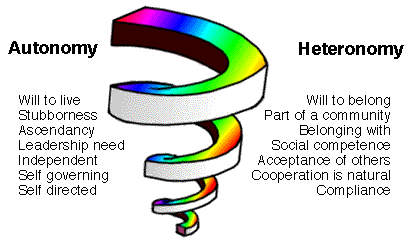
We have decried using instinct to explain human behavior, so, in its
place we might say that there is a mysterious internal spring that keeps
revolving, thrusting the person, child to elder, into the quest for self,
for autonomy. Ever turning, the revolution then slowly counters with a
need for acceptance and understanding outside the self. Autonomy * heteronomy
is the motor or drive shaft. It is the revolutions of, or pressure from,
self preservation, self fulfillment and the alternating press for approval
from others, a sense of fruition, that comes only through feeling love
and acceptance by and for others. This is a part of what motivates and
mitigates student actions (Piaget, 1965).
We each only have our “self” and it is a delicate dance of shifts in power,
control, manipulations, a carefully orchestrated dance of paradox - moving
between self survival and the continuation of the social order; between
self fulfillment and the realization that fulfillment of self comes through
attainment of personal relationships with others. It is a set of intricate
maneuvers, moving between full immersion in self absorption and the belief
that those who lose themselves are those who find themselves, that the
ultimate lesson in life may be the journey to realization that every dance
is more powerful as a conjunction (Montouri, & Conti, 1993).
The “self” further develops as a construction of the messages from significant others as they pass through and become the “neural net” of who we are, what we believe, what we attend to and how we label the biochemical (internal) sensations we receive as well as the spin we put on external happenings. Powerful messages come from those we identify internally and developmentally as referents. As described earlier, the two-year-old gets nearly all relationship messages from parents, the seven-year-old receives messages from many sources, but attends most deeply to those from parents and teacher. For the adolescent, parent and teacher messages are strong, but many youngsters heighten the volume and density of peer messages, and in effect tune others out. This allows parent and teacher messages to be discounted in favor of best friend or gang communication. In effect, the adolescent has many radio station signals, but the peer stations have the million megawatt signaling strength.
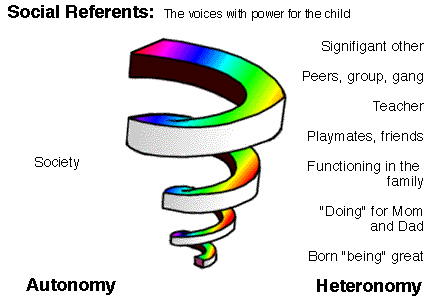
Referent sources might be defined as those people who are fully involved in the personal life journey, those who contribute to esteem for self and esteem of others. Individuals who are emotionally intact may have the best balance between the two counter forces, who we are to self and who we seem to be to others or how we believe that we are viewed by others. In fact, esteem with respect to referents, may involve a three or four dimensional view of self; how we see ourselves, how others see us, how we believe they see us and how attuned we are to others’ ideas of who we are and how proficient we are at accurately valuing their opinions (Luft, 1969).
This in an integral part of the complex set of factors that contribute to power. Students who value teacher messages empower the teacher to provide input that is attended to and accepted. If the teacher is not a referent, has failed to establish relationship with the student, or the student is not receptive to or is untrusting of teacher messages, then the messages are more likely to be viewed as controlling and countered by the student. The more youngsters entrust us with their world view, the more powerful a referent we become and the more deeply valued the communications become. An adult who maintains a relationship as part of a child’s inner circle has great potential for enhancing learning, but simultaneously has responsibility to realize that a few words or actions can disenfranchise the child’s desire to learn or to obey, and can anger, enrage or vilify.

Interplay of Wills
If we truly want to enhance learning, cooperation and motivation in youth,
then adults in authority will have to make changes. We may need to redefine
how we will want to behave, knowing what we know of children, what we
know of child development, what we know of ourselves. As we shift from
management of environment to empowerment of children and shared management,
we move closer to democracy in the classroom. A belief in the value of
democracy in child rearing is neither widely fostered nor seen as desirable
by many. Empowerment is a skill few have. We have not taught the need
for nor ability to balance adult needs and expectations with children’s
needs, yet this is crucial. Integrating individual needs with group needs,
the inculcation of knowledge with the personal sense of fulfillment, the
need for contemplative reflection with earnest and purposive interaction
in search of answers provides the cooperative integration balanced with
the competitive nature of personal “a-ha”.
This recognition frames a central issue. Parents and teachers have an historic unwritten expectation of being the authority -- “MY home and you will not infringe upon the power I wield”; -- MY classroom and I have a right to teach'" “Who are you to tell me what to do?” “Are you paying the freight around here?”; “What gives you the authority to...” The sense of power and historic prestige is one of the few obvious benefits of parenting and an unfortunate motive if it is the reason for teaching.. How can we move a generation of parents and teachers toward a new perception of power, a more sophisticated use of children’s need to know and society’s need for self responsible, civil adults?

Parents and teachers have a need to contain youngsters, to rule the
family or maintain a preferred classroom setting, to feel the need to
make all the decisions and thus expedite an agenda, use time wisely, keep
everything on track. Unfortunately, this often forces youngsters to pull
away, to hide choices, to learn to lie, deceive and manipulate to get
needs met. Open communications and shared governance, governance based
on ability to make wise choices, to take counsel and share mistakes without
fear of reprisal, provide a path for healthy individuality in the milieu
of family as community. It allows the child to grow and the family to
keep pace. It allows the youth to make mistakes in the haven of support,
rather than rebelling or leaving the family and having no real support
or counsel in the initial attempts at independence.
Changing from the way we have conducted ourselves and moving to this new stance involves thinking about power. Power has a give and take element involved. Control does not. In a relationship, it is possible for power to be shared, or for a person to see themselves as sharing power. That sharing can be misinterpreted as willingness to be controlled. In a submissive class, the teacher is asking students to give permission to teacher to make the decisions, and also takes responsibility for learning or lack of it. Such power, by its very nature lends itself to abuse. Most stark experiences children recall in school have to do with their trust or self empowerment being stripped.

More often, however, the students abuse power, giving the teacher the shadow of power while refusing to fully engage in learning, renaming every request a power struggle. Every conflict then is fodder for justifying lackluster energy for learning tasks. Changing the nature of evaluation might address this. We know evaluation and assessment are often used as both the container and the continuum, the snapshot of one moment in time by one learner on a discrete task and concurrently, the summative culmination of many completing a course of study. It may denote achievement and aptitude, learning and reflection, creative answering, cheating, guessing and certitude in 100 questions or less. If students are to feel the responsibility of learning rather than just the delight of free flight away from teacher purposes, evaluative tools must reflect student input, student expertise in reflection, introspection, and honest assessment of product. This is an exhilarating concept, since student ability to accurately assess learning signals teaching * learning as integration. Students involved in this dimension of reflection will feel empowered and it will show.
Empowered individuality and community is energizing. It provides a cogent source of evaluation, honors the personal satisfaction that comes in merging personal success with community. Adult as facilitator and model acquires true power in the classroom or family, providing the keys for effective performance and best practice by understanding youth, recognizing the nature of will and sharing responsibility, thus leading to greater personal and social health and maturity. The dance of wills becomes a touching performance of child and adult growth, and the classroom or home, a learning climate rather than a battle ground.
Compliance is something that has often been valued as an outcome for youth. In fact, training and education that results in compliance may be a worthwhile commodity for an autocracy, but it is not so truly valuable in a democracy. The teaching of options and skills for making choices both for our own benefit and the benefit of others would certainly serve self and society in a more appropriate manner. When a person perceives options and has the dignity of choice, that person feels empowered and motivated. The youth who is being taught to make appropriate choices and who has the freedom to do so, has the potential to pursue education and personal development as a way of life.
 The effective
adult recognizes autonomous behavior and remembers how to handle and defuse
misuse of control when it appears. It is crucial to everyone's well being
and allows the child to trust the adult and feel secure in the situation.
The effective
adult recognizes autonomous behavior and remembers how to handle and defuse
misuse of control when it appears. It is crucial to everyone's well being
and allows the child to trust the adult and feel secure in the situation.
The ultimate
goal is to move youngsters beyond compliance, assisting them to assume
personal responsibility and gain competence. It is vital to provide youngsters
with practice in the ability to recognize multiple options and then make
appropriate choices. It is essential that the developing child become
competent at seeing more than personal gain and develop beyond an egocentric
perspective of issues and concerns. The maturing youth gains the vision
of the importance of meeting more than personal gratification, of moving
in a social milieu rather than choosing in isolation.
Structure and Nurturance
Studies in widely divergent fields of human science research give credence
to the importance of structure and warmth as a part of the ambiance or
setting for "best practice" in the classroom. They give added
significance to the value of blending the being and doing forces, of caring
deeply for the child as a person and letting the child know of that concern,
but also providing a definite and explicit structure.
Human beings need warmth and high demand as Coopersmith (1967) discovered in looking at self-esteem in children and the types of home environments which led to youngsters with an excellent sense of well being. Children who grow up to become competent, mentally healthy adults also had a similar legacy, Becker (1964) discovered.
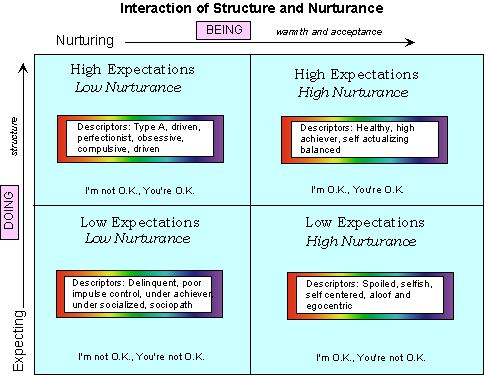
That legacy was found in a setting which provided psychological autonomy
or freedom to be the self along with high expectations and firm guidelines.
It is vital that we utilize these dynamics as a foundation for structuring
the best educational situation. In education we serve self and student
best by placing reasonable and lofty demands in the path of the child.
Then we facilitate the student's abilities to reach those expectations
by expressing faith in their ability to accomplish the task, moving back
so that the student senses our trust in him/her as a doer, and giving
appropriate recognition and praise for the job which is completed.
In gentle, well earned praise we honor the being of the responsible student as well as validating the doing of the task. In this manner we strengthen the whole child and give impetus to the work ethic, to the student's need to know, to the internal competence of the child and we do not hamper the child's intrinsic motivation by sending a message that compliance is more important than self competence, that our way is the only way, that the cues for well being are dependent upon satisfaction of the teacher.
The effective
educator provides a structured, well defined educational setting with
high expectations and works to establish intrinsic motivation while allowing
the student to take personal responsibility for learning. This setting
then fosters student desire to continue to work with intrinsic rather
than extrinsic motivation, to press for personal excellence rather than
comparative effort, to learn because of self satisfaction rather than
pursing someone else's goal, to set up the habits and patterns of self
as learner and self as initiator rather than losing interest in the pursuit
of knowledge when others are not structuring, rewarding or punishing achievement.
Many teachers recognize a familiarity in some of these concepts. Occasionally educators have moved toward a notion of caring about students, recognizing each child as an individual. However, educators backed away from the concepts in the mid 1970's, and did so because students were not achieving at potential, scores were not soaring, competencies were not being met. An important piece was/is missing. Structure must underlay the forgoing concepts and the teaching/learning interrelationship. High demand cannot be given a back seat. The teacher cannot be afraid of "damaging" the child by stepping in and expressing new ideas, or stating that s/he is accepting a student's first paper as a draft rather than a final product.
Before launching the student on the task it is important to have rules,
procedures, expectations, practices and routines in place. When it is
likely that a student will succeed, it is also likely that the skills
for success are in the hands of that student. When we demand that a child
take responsibility for self and behavior, it is appropriate if that child
has been taught what responsibility is, what accountability is about and
how to achieve and maintain them. It is equally important that the student
become involved in quality control and in demonstrating mastery. Then
the grading process must also reflect the students’ evaluations and achievements.
And so we add
another dimension to the effective classroom - the teacher provides and
instills a workable structure, a set of procedures and skills which will
insure student success. The teacher moves into the role of facilitator
with students, but only after insuring that skills and ability to succeed
are in place. Further, the teacher stands by, ready to nudge, approve,
suggest. Though the teacher is not engaged in the doing, the teacher maintains
engagement with the student, with the “being” who is doing. Further, the
teacher facilitates quality control and assists the student to monitor
gains and recognize both strengths and weaknesses.
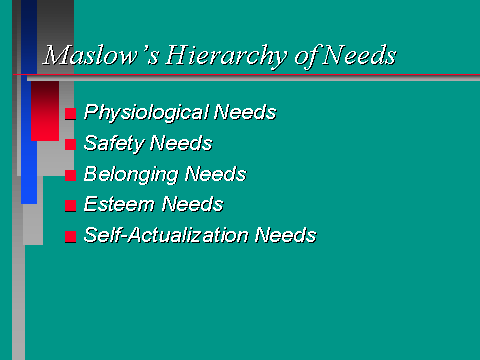
Maslow (1968) worked for many years to increase understanding
of human motivation, believing that providing teachers with a better grasp
of human nature had the potential for improving education. His work on
basic needs has been utilized repeatedly in explaining human behavior.
Basic Needs
The first steps in this hierarchy are the crucial points for classroom teachers. Without the basic needs, air, food, water, a person cannot pay attention to instruction. If a student is having an asthma attack, cannot get air, then curiosity, a love of beauty, even feeling loved take no part in the immediacy of the moment. The same can be true of food and water. If starving, knowledge, other than how to get food, seems of little importance, in fact may not even impinge on consciousness.
The second step in the hierarchy, the need for structure and safety, is one of the most frequently overlooked principles of human nature. People desire, no, need structure. We love ritual, feel comfort from knowing what will happen next, what the rules are, what expectations will consistently be held for them.
One of the telling occurrences in classrooms which underscores this happens when a substitute is in charge of the classroom. The students spend the day telling the teacher replacement: "We don't do it that way." " That's not how you're supposed to do it, 'cause we never do it that way!" "It's not time for that, yet." "Aren't you going to ...." Mr. Jones always says . . ."
It is human nature to desire ritual. It is not always "boring" though we have often said that it was, to have people say or do the same thing repeatedly, particularly if that repetition gives comfort. We love our comfortable jeans, our worn Afghan, the place in each classroom from which we wish to observe. In fact, many of us become panic stricken if we are in an unfamiliar situation without comforting cue. We want stimulation, but we also want security. We want change, but we love returning to the old familiar refrain.
The effective
educator perceives the value of recognizing and meeting the basic needs
of students. When children are hungry, weary, in need of physical comfort,
it is a very powerful tool to be able to care, and to show that caring
by meeting those needs. And it is just as important to understand and
meet the need for structure, consistency and safety.
Full Speed Ahead
Balancing Being and Doing
Some youngsters are not ready to function well in a community setting.
The following suggestions will help the youth move into a more functional
mode. Rather than switching to the autocratic governance model, ask everyone
to join in utilizing the following steps.
1) Increase the structure in the community and help members of
the system practice appropriate behavior within each setting.
2) Provide models for appropriate behaviors and provide a means
whereby system members or self may make restitution when errors occur.
Never punish self or allow others to feel punished.
3) Develop and communicate messages for others which let them know
that you like who they are, not just what they do. Do the same for self.
4) Implement a working style which highlights each person as an
important individual. Remember to include yourself.
5) Emphasize the importance of working at a task and coming to
completion, and include the step of self appreciation for a job well done.
6) Provide ways for youngsters to alert you or others to difficulties
in tasks which feel too difficult, and work out ways for children to tackle
those tasks in step appropriate fashion, always capitalizing on the energy
and motivation that comes from success and avoiding the destructive feelings
and lack of task commitment that come from total and abject failure. That
includes circumventing the anxiety that develops if a child believes that
nothing is adequate.
7) Nourish children in understanding the excitement and buoyancy
of energy that comes from a great challenge which is met and a "mountain"
climbed.
8) Become proactive in management techniques:
a. Teach the concept of members having self-control and being in
charge of themselves, their bodies, their time, their work.
b. Base management on constructive and positive statements.
c. Recognize and honor those who are giving a good accounting of
their time and energy -- and remember to include self.
d. Teach and then enforce members valuing one another -- "Do
unto others as you wish others to do unto you" -- .
e. Learn to ignore inappropriate behavior and refuse to spend time
communicating dissatisfaction to errant members.
f. Focus on motivations for misbehavior and address the causes
of dysfunction and the needs of the person rather than nagging at the
symptoms.
g. Motivation and nurturance become a major focal point of energy
and time as a function of communicating and valuing
h. In order to have esteem in DOING, people must be able to DO.
Therefore, more than ever before, we must concentrate on accelerating
real accomplishment of important system and life skills.
i. Use multiple learning and communication style approaches so
that each person has an opportunity to develop and use personal strengths
j) Develop self understanding and recognition of the rules and
consequences involved in the learning process or family situation, viewing
self as leader.
k) Consistently verbalize for those who break the rules that what
they are doing is not appropriate, but that their being is safe and lovable.
l) Work on esteem needs for the self as well as working on the
esteem needs of children. In giving self messages, be certain to follow
the same general guidelines - change behaviors, accept self; recognize
the doing as inappropriate and make corrections, then let yourself get
"off the hook".
m) Project self as a likable person - using referent power and
the historical role of parent or teacher to gain love and respect from
youth.
You should now:
Go on to My Autobiography
or
Go back to Essentials
 E-mail J'Anne
Ellsworth at Janne.Ellsworth@nau.edu
E-mail J'Anne
Ellsworth at Janne.Ellsworth@nau.edu
Web site created by the NAU OTLE Faculty Studio

Copyright 1998 Northern Arizona University
ALL RIGHTS RESERVED