Each
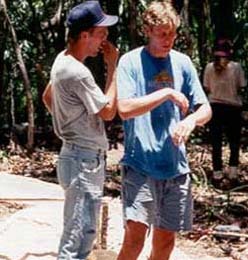
student will design and carry out a local ethnoarchaeology research project
within the village of Succotz. Observations of local customs and practice
will be used to formulate generalized ideas about how residues of modern
behaviors may be observed in the archaeological record.
Field
School Schedule
July 1, 2000: Students
arrive at Belize City and are taken to Succotz village in western Belize.
PHASE ONE: VILLAGE
STAY AND INTENSIVE TRAINING
| July
2, 2000 |
AM |
Introduction
to Field School participants, organization, acclimatization |
|
PM |
Lecture
Topic: Introduction to the Maya and archaeology |
| July
3, 2000 |
AM |
Field
Training: Survey |
|
PM |
Lecture
Topic: Maya Settlement Survey in practice |
| July
4, 2000 |
AM |
Field
Training: Excavation Techniques |
|
PM |
Site
Visitation: Other project research |
|
|
Lecture
Topic: Classic Maya Civilization, the have and have-nots |
| July
5, 2000 |
AM |
Field
Training: Data collection, notebooks |
|
PM |
Lecture
Topic: Ethnoarchaeology, what can we learn about the past? |
| July
6, 2000 |
AM |
Field
Training: Begin ethnoarchaeology projects |
|
PM
|
Lecture
Topic: Local Maya History |
| July
7, 2000 |
AM |
Continue
ethnoarchaeology projects |
|
PM |
Guest
Lecture: Maya caves |
| July
8, 2000 |
|
Free
Day |
PHASE TWO: VACA PLATEAU
- PREPARATION AND OVERNIGHT
| July
9, 2000 |
AM |
Day
hike to field camp, tour Minanha and prepare for field research |
| July
10, 2000 |
AM |
Prepare
gear |
|
PM |
Lecture
Topic: Maya agriculture, Belize flora & fauna |
| July
11, 2000 |
AM |
Hike
to camp site and prepare bedding |
|
PM |
Begin
field research |
| July
12, 2000 |
AM |
Field
work all day |
| July
13, 2000 |
AM |
Field
work |
|
PM
|
Pack
up camp and hike out, ride back to Succotz |
| July
14, 2000 |
AM |
Laboratory
analysis |
|
PM |
Lecture Topic: Analysis and Interpretation in Maya Archaeology |
|
|
Epigraphy
and Calendrics |
| July
15-16, 2000 |
|
Free
Weekend (optional field trip) |
PHASE THREE: MINANHA
REGIONAL SURVEY FIELD RESEARCH
| July
17, 2000 |
AM |
Hike
to camp site and prepare bedding |
|
PM |
Begin
field research |
| July
18-19, 2000 |
|
Field
work all day |
| July
20, 2000 |
AM |
Field
work |
|
PM |
Pack
up camp and hike out, ride back to Succotz |
| July
21, 2000 |
AM |
Laboratory
Analysis |
|
PM |
Lecture
Topic: Maya Social Organization |
| July
22-23, 2000 |
AM |
Free
Weekend: Ethnoarchaeology Project due |
PHASE FOUR: MINANHA
REGIONAL SURVEY FIELD RESEARCH
| July
24, 2000 |
AM |
Hike
to camp site and prepare bedding |
|
PM |
Begin
field research |
| July
25-26, 2000 |
|
Field
work all day |
| July
27, 2000 |
AM |
Field
work, backfill units |
|
PM |
Close
up camp and hike out, ride back to Succotz |
| July
28, 2000 |
AM |
Laboratory
Analysis |
|
PM |
Prepare
for exam |
| July
29, 2000 |
AM |
Final
Exam |
|
PM |
Post-session
meeting |
| July
30, 2000 |
AM |
Good-byes,
truck leaves for Belize City, airport |
CSU Northridge
is responsible only for providing instruction and appropriate academic
credit.
|